€30,000+
Investment amount


The Malta Global Residence Programme, launched in 2013, is aimed at non-EU, non-EEA, and non-Swiss nationals who want to become tax residents of Malta. The programme offers a flat 15% income tax rate under a special tax regime, helping individuals reduce their overall tax burden.
To qualify, applicants must buy or rent property in Malta, pay a government fee, and commit to a minimum annual tax of €15,000. There’s no need to live in Malta full-time, but you must not spend more than 183 days per year in another country.
The programme allows you to include close family members — spouse, children, siblings, parents, and grandparents. Household staff can also be included, but their income is taxed at standard rates.
A Malta residence permit gives you the right to live in Malta and enter the country at any time while your permit is valid.
Relocating to Malta is optional for investors, not mandatory. Instead, you can establish a “Plan B” home in Europe by renting or buying property and opening a local bank account.
With Malta residency, you can travel freely across the Schengen Area — up to 90 days within any 180-day period — without needing a separate visa.
Foreign income brought into Malta is taxed at a flat rate of 15%, while foreign income kept abroad is not taxed at all.
Compared to other European countries where investment residence permits start at €250,000, Malta’s programme is relatively affordable. The total cost starts at around €30,000, covering rent, government fees, and taxes.
You can include your spouse, children under the age of 25, and dependent parents and grandparents from both sides of the family.
Malta residents can work or start a business in the country. Malta’s tax system is widely regarded as business-friendly, offering potential advantages for entrepreneurs and shareholders.
Although the standard corporate tax rate is 35%, most companies qualify for refunds or deductions, which can reduce the effective rate to between 0% and 10%.
You’re not required to live in Malta permanently to keep your residency. Yet, you must have a property available for your personal use year‑round. Also, you shouldn’t spend more than 183 days a year in any other single country.

To obtain a Malta residence permit, an investor must buy or rent a residential property in Malta and pay an administrative fee and taxes. Additional costs include health insurance for each family member and legal service fees.
If you choose to rent property, the minimum cost to get a Maltese residence permit starts from €34,250. To keep the permit each year, you’ll need to spend at least €23,750 — this includes a minimum of €15,000 in income tax and €8,750 in annual rent.
| Renting real estate | €8,750+ per year if in the south of Malta or Gozo or €9,600+ per year if in other regions |
| Administrative fee | €6,000 |
| Annual taxes | €15,000+ |
| Documents translation and apostille, notary fees | €4,000+ depending on the particular case |
| Health insurance | €500+ per person |
To obtain a residence permit, the investor must buy a property in Malta and keep it in their name. They can only rent it out or sell it if they either become a Maltese citizen or decide not to renew their residence permit.
| Buying real estate | €220,000+ if in the South of Malta or Gozo or €275,000+ if in other regions |
| Administrative fee | €5,500—6,000 |
| Annual taxes | €15,000+ |
| Fees, taxes and services when buying real estate | At least 6.5% of the property price, that is €14,300+ |
| Documents translation and apostille, notary fees | €4,000+ depending on the particular case |
| Health insurance | €500+ per person |
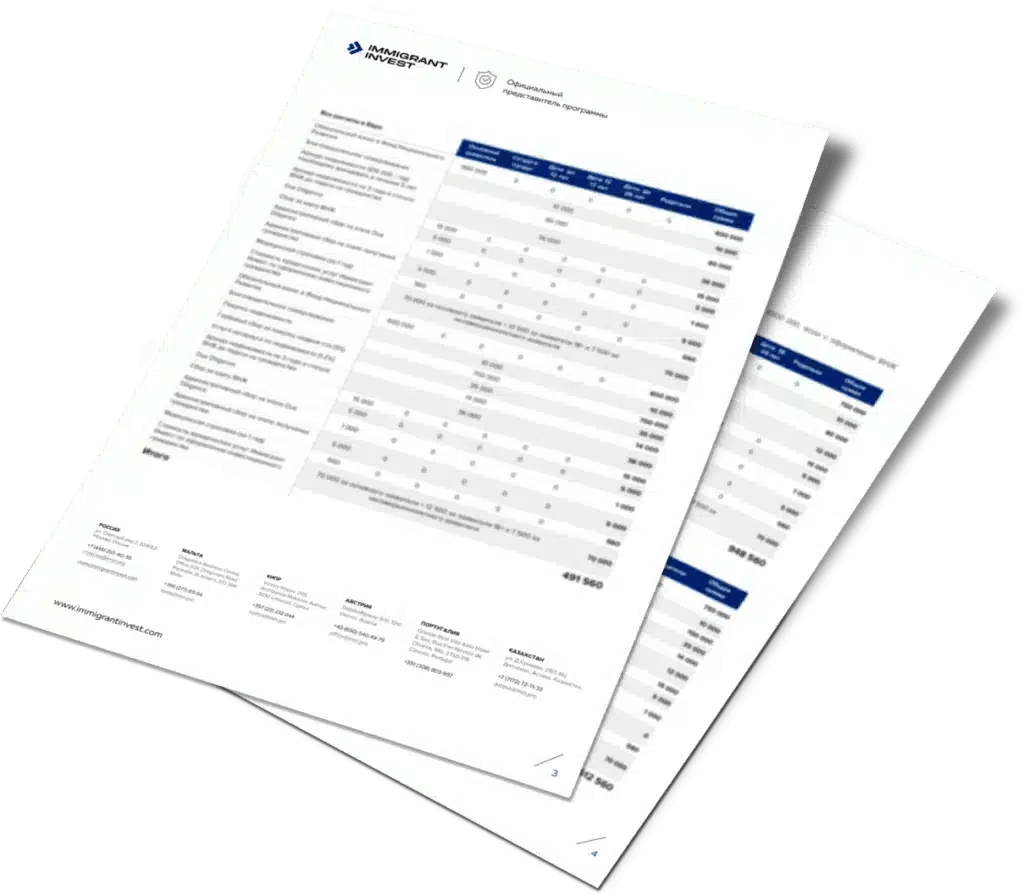
Taxes in Malta for participants of the Global Residence Programme are applied at the following rates:
Even if you transfer little foreign income into Malta, you must still pay a minimum of €15,000 in tax each year. This makes the regime most beneficial for those who plan to remit at least €100,000 annually, as otherwise the effective tax rate exceeds 15%.
The minimum €15,000 does not cover any Maltese-source income; that is always taxed at 35%.
You must also maintain your status as a Maltese tax resident. This does not require you to spend more than 183 days per year in Malta. However, you must not spend more than 183 days in any other single country within the same year. If you do, your tax residency may automatically shift to that country.
To qualify for the Malta GRP, applicants must buy or rent residential property in Malta to serve as their main home. The property must be suitable for the applicant and their family, and must remain in their control for as long as they hold the residence permit.
The required minimum value of the property depends on where it is located.
If purchasing:
If renting:
Participants are not allowed to sublet, rent out, or sell the qualifying property while under the programme. If they stop renting or sell the home without securing a new qualifying property, their GRP status may be revoked. These rules ensure the property is used as a genuine residence, not for investment or income purposes.
Getting a Maltese residence permit under the Global Residence Programme is a structured process that takes at least 3 months. It involves checks, paperwork, and property arrangements — but with expert support, it can be smooth and stress-free. Here’s how it works with the guidance of Immigrant Invest.
Before starting the formal process, our certified Anti-Money Laundering Officers carry out a confidential internal check. They review your documents and screen international databases to identify any potential risks.
If anything needs fixing, our legal team will advise you. This quick step helps avoid delays later on and minimises the risk of rejection to 1%.
Immigrant Invest is a licensed agent for the Malta Global Residence Programme. We guide you through every stage of the process, from preliminary Due Diligence and document preparation to final approval and beyond. Backed by 20 years of experience, we provide reliable, personalised support to make the process smooth and successful.
With a 99% success rate, our in-house compliance team conducts detailed checks before any application begins, helping to avoid risks and rejections. If any issues arise, we suggest better alternatives to ensure the best outcome for you.
With offices in 9 countries, including Malta, our team of international lawyers and local professionals ensures your application is handled in line with local regulations and supported at every step — including in-person assistance during your visits to Malta.
With over 20 years of experience and established partnerships in Malta, Immigrant Invest provides strategic legal guidance for individuals pursuing Maltese citizenship.
A multidisciplinary team of legal, compliance, and real estate professionals accompanies clients at every stage of the process — from preliminary Due Diligence and residency arrangements to the preparation of a substantiated proposal and navigation of the multi-layered evaluation and approval procedure.
Each phase is handled with precision, discretion, and strict adherence to Maltese legislation, ensuring a seamless, transparent, and professionally managed pathway to citizenship.


Schedule a meeting at one of the offices or online. A lawyer will analyze the situation, calculate the cost and help you find a solution based on your goals.


At Immigrant Invest, our support doesn’t end with your residence approval — we continue to assist you and your family with every step that follows.
We handle all paperwork and guide you through the process of renewing your residence cards, so you never miss a deadline.
If your residence card is lost or damaged, we take care of the entire process — from preparing documents to collecting your new card.
We help you choose a suitable property remotely. Our team checks the apartment, records a video tour, and supports you with the rental or purchase agreement.
We prepare all required documents and fill out the forms to make the process as simple as possible.
We assist with obtaining police clearance certificates, submitting the annual compliance form, and offer access to trusted tax advisers for expert financial guidance.
Clients’ names and photos have been changed to comply with a non-disclosure agreement.

I’ve had several online consultations so far, and the attorneys here clearly are well-versed in Maltese laws and the Malta Global Residence Programme requirements. However, some of our meetings had to be scheduled at unusual hours.

I had a brief difficulty reaching them by phone, but a quick email resolved the issue immediately. Aside from that, I have no complaints. The team is exceptionally knowledgeable. I spoke with Julia for about an hour and gained more insights into the Malta residence permit than from numerous consultations with other companies.

A great choice for anyone seeking residency services. The team was both professional and well-informed. Although we faced some challenges due to local bureaucracy, Immigrant Invest kept us well-informed throughout the process. We truly appreciate their dedication in securing our Malta residence permit.
| Comparison factor | Malta GRP | Malta Permanent Residence | Malta Digital Nomad Visa |
| Financial requirements | Investment of €30,000+ | Investment of €182,000+ | Remote income of €3,500+ per month |
| Eligible family members | Spouse, children under 25, siblings, parents, grandparents | Spouse, children under 29, parents, grandparents | Spouse, children of any age |
| Tax benefits | 15% on foreign income remitted to Malta, and 0% on income kept abroad | None | 0% income tax in year 1, and 10% from year 2 onwards |
| Obtaining period | 3+ months | 6+ months | 5+ months |
| Permit validity | 1 year, then 2-year renewals | Lifelong status | 1 + 1 + 1 + 1 years |
| Path to citizenship | Yes, by naturalisation | Yes, by naturalisation | No |