Start your path to a Maltese status with the guidance of a licensed agent, trusted by 10,000+ clients

Maltese legislation provides several legal routes for foreign nationals to obtain residence permits, permanent residence, or citizenship by naturalisation based on merit. Each status is governed by its own legal framework, procedures, and administrative requirements.
Applicants are subject to Due Diligence and background verification conducted by the competent authorities.
The statuses provide different rights and obligations.
Malta citizenship grants the full legal status of a national of Malta. Citizens are expected to comply with the laws and regulations of Malta and the EU, including tax obligations if applicable.
Malta permanent residence is granted for life. Permanent residents must maintain or keep renting their property. Holders may reside in the country long-term and travel within the Schengen Area for short stays under the rules of the Schengen Area.
Permanent residents do not obtain Maltese nationality or the EU freedom of movement rights granted to citizens.
A residence permit provides the right to live in Malta for a defined purpose and period.
Permits must be renewed and depend on maintaining the underlying basis for residence:
Maltese residents can freely travel to 29 Schengen countries and stay there up to 90 days out of each 180 days.
All statuses allow the holders to visit Malta anytime, even if the country’s borders are closed.
Our experts in investment migration will analyse your tasks. Our Compliance Department will carry out preliminary Due Diligence. This approach will help you get the most suitable status.


Malta residents can travel across the Schengen Area without visas and stay for up to 90 days within any 180 days.
Individuals with Maltese residence permits can enter the country at any time with their families. They can live in Malta for an unlimited amount of time.
In comparison, a Schengen visa allows the holder to spend only 90 days in 180 days in Malta.
Malta investment visa provides access to the services of European or US banks. Investors open bank accounts abroad to keep savings in a hard currency, fasten payments with business partners worldwide, and decrease transaction costs.
Many investors choose Malta for its high living standards. A residence permit allows living, studying, and doing business in Malta, but not working.
Children of Maltese residency holders can enrol in local schools and universities under the same admission process as other residents, with tuition fee exemptions available in some cases.
An investor can register companies in Malta and other EU states. Many investors transfer their businesses to Malta using opportunities for beneficial taxation.
Registration of a business in the EU helps quickly forge partnerships in developed countries. Geopolitics has little effect on the business.
Villas and apartments located in developed European countries bring up to 15% of rental income per year. However, many EU states, such as Austria, restrict property purchases to EU residents or citizens. Malta residency gives access to investing in liquid European real estate.
Immigrant Invest has operated since 2006. During this time, we helped 10,000 investors and their family members get residence permits and permanent residence in Malta.
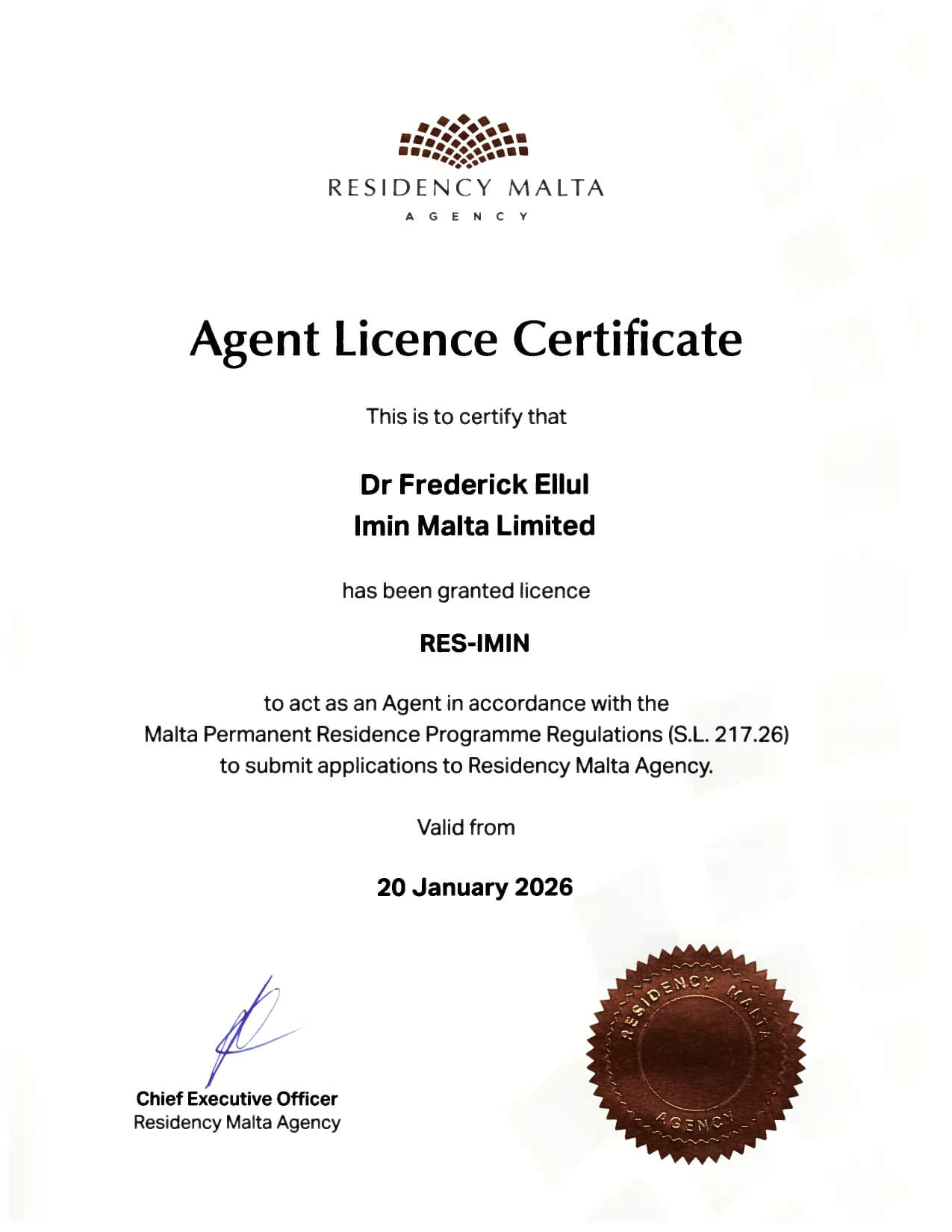
Investors apply for Malta residency only through a licenced agent; one cannot apply by themselves. Immigrant Invest has passed government Due Diligence and got a licence to prove it. Thus, we can act on the investor’s behalf during application procedures in Malta.
Our offices work in 11 countries. The lawyers assist investors at each step. Thanks to an individual approach to each investor’s task, we have the highest success rate in the industry: 99% of our clients’ applications get approved.
The investor gets a residence permit or permanent residence under special government programmes. It is less expensive to obtain a temporary residence permit than a permanent one. However, a residence permit must be renewed yearly, while permanent residence is granted for life.
| Status | Permanent residence | Residence permit | Digital Nomad Visa |
|---|---|---|---|
| Legal basis for granting a status | Malta Permanent Residence Programme
Legal basis for granting a status
|
Malta Global Residence Programme
Legal basis for granting a status
|
Immigration Act, Chapter 217 of the Laws of Malta
Legal basis for granting a status
|
| Financial requirement | €169,000+ investment investment
|
€30,000+ investment investment
|
Income of €42,000+ per year |
| Time frame | 6+ months Time frame
|
3+ months
Time frame
|
2+ months
Time frame
|
The Malta Permanent Residence Programme has been operational since 2015. This program is suitable for investors seeking lifelong residency in Malta or wishing to relocate to the country. There is no requirement for permanent residency holders to live in Malta continuously.
To qualify for the Malta investor visa, the investor must undergo Due Diligence, make a non-refundable contribution, purchase or lease property, and confirm assets worth more than €500,000 for the first five years.
In addition to the investor, their spouse, children under 29, and parents and grandparents can also obtain Maltese permanent residency.
Difference in investment amounts when renting or buying a property:
| Rent | Purchase |
|
€99,000 as a €14,000+ as an |
€99,000 as a €375,000+ as a |
The Malta Global Residence Programme was launched in 2013. The programme is suitable for investors who want to become Maltese tax residents. The change of tax residency is mandatory. In addition, the investor mustn’t spend more than 183 days a year in another country. However, there is no requirement to live in Malta all the time. The investor pays an annual tax of at least €15,000.
The investor passes Due Diligence, makes a non-refundable contribution, and buys or rents a property.
A spouse, children under 25, siblings, parents and grandparents can become Maltese residents with the investor.
Difference in investment amounts when renting or buying a property:
| Rent | Purchase |
|
€6,000 as a €8,750+ as an |
€5,500+ as a €220,000+ as a |
The Malta Nomad Residence Permit was introduced in 2021. The programme is suitable for freelancers, self-employed, and remote workers with an annual income of at least €42,000 outside Malta. Applicants cannot work for Maltese companies.
The Malta Digital Nomad Visa is valid for 12 months. The status can be renewed 3 times for the same period. Digital nomads must buy or rent housing for the entire permit validity period. There is no requirement for the minimum cost of the property.
A spouse, children under 18, and financially dependent children over 18 can get a Malta Nomad Residence with the main applicant.
Requirements:
| €42,000+ in annual income |
| Rented or owned housing |
Maltese legislation provides for the possibility of naturalisation in cases of exceptional merit. Citizenship may be granted to individuals whose achievements or activities are considered to bring a significant benefit to Malta or to humanity more broadly.
Applicants submit a letter of proposal where they outline the exceptional service already delivered or planned. They are also expected to demonstrate lawful residence in the country and evidence of integration with Malta.
Assessment is discretionary, and each request is considered on a case-by-case basis in accordance with Maltese legislation. The request assessment includes a comprehensive background verification.
We share expert commentaries in the blog: learn more about news and changes in residence permit by investment programs, the nuances of starting a business, how to choose a university, and life in Malta.
Two government-approved Maltese programmes offer a residence permit or permanent residence by investment. The programmes differ in time frames, investment amounts, and additional requirements. For example, the Malta Permanent Residence Programme requires proof that the investor has assets worth at least €500,000, or €650,000, where at least €75,000 are liquid financial assets.
A residence permit allows the investor to live in Malta with the family and run a business in the country. They can travel to the Schengen countries without visas, presenting residence ID cards. Maltese residents can stay in other Schengen states for up to 90 days out of 180.
The investor becomes a Maltese tax resident and pays an annual tax at a flat rate of 15% but not less than €15,000.
The residence permit obtained under the Malta Global Residence Programme must be renewed every year. The investor proves they have paid the tax and got a residential address in Malta.
Another investor’s duty is not to spend more than 183 days a year outside Malta.
Permanent residents have the right to live in Malta and visit other Schengen countries without visas. There are no requirements to spend all year in Malta, have proficiency in Maltese or English, or prove the knowledge of country’s history.
However, the investor must prove that they possess assets worth at least €500,000, including €150,000 as financial assets like deposits or securities. Another option having assets of at least €650,000, including €75,000 as liquid financial assets.
Permanent residence is valid for life, but the ID card of a permanent resident must be renewed once every five years.
The Maltese passport allows citizens to move around the EU countries without limits. For example, to live in any state of the region without obtaining additional permits. If the investor’s children get Malta citizenship, they can study at any EU university without getting student residence permits.
Malta has visa-waiver agreements with 169 countries, including the USA, the UK, and Australia. Thus, Maltese citizens can travel the world freely and enjoy a cosmopolitan lifestyle.
No, Malta doesn’t have a citizenship by investment programme.
Citizenship may be granted by naturalisation based on merit. Under this framework, requests are assessed individually by the competent authorities, including the Community Malta Agency. The evaluation focuses on whether the applicant’s achievements, activities, or proposed contribution provide a clear benefit to Malta or to humanity more broadly.
Financial capacity on its own is not sufficient for naturalisation by merit. Applicants are generally expected to demonstrate genuine links with the country, which may include lawful residence, integration, and a well-documented proposal describing the exceptional service already delivered or planned.
As the process is discretionary, there are no guaranteed outcomes, fixed investment thresholds, or standardised qualification criteria. Each request for naturalisation is assessed on a case-by-case basis under Maltese legislation.
A residence permit, permanent residence and citizenship allow the investor to move to Malta with the family.
Expenses depend on the status the investor wants to obtain. A residence permit requires the least investments. Costs start at €30,000.
The investor must spend at least €169,000 to get permanent residence.
It is not possible to obtain Malta citizenship by investment.
No, you cannot work for a Maltese company. Foreigners can apply for a Malta Nomad Residence only if they are freelancers, self-employed, or remote workers of foreign companies.
Digital nomads were previously not required to pay taxes on foreign income in Malta. From December 2023, they are subject to income tax at a rate of 10%. However, digital nomads are exempt from income tax for the first 12 months after obtaining a Malta Digital Nomad Visa.
To obtain Malta Nomad Residence, applicants need to confirm an annual income of €42,000 or more from sources outside of Malta.
Obtaining residency in Malta is considered straightforward for investors who meet the programme’s financial and Due Diligence requirements. The government offers two clear, regulated routes: Malta Permanent Residence Programme and the Malta Global Residence Programme.
They outline specific investment thresholds, property obligations, and background checks. Applicants are not required to live in Malta full-time or pass language tests. The process is handled through a licensed agent who guides investors at every stage, making the application efficient and transparent.
The process of obtaining permanent residency in Malta takes approximately six months or longer under the Malta Permanent Residence Programme. This period includes Due Diligence checks, document preparation, and application review by Maltese authorities.