In 2025, Malta closed its citizenship for exceptional services by direct investment route in response to mounting pressure from EU institutions. The country’s citizenship legislation, however, continues to provide for naturalisation in cases of exceptional merit, assessed individually by the competent authorities.
Investors still have long-term residence options with the prospect of citizenship, both in Malta and across the EU.



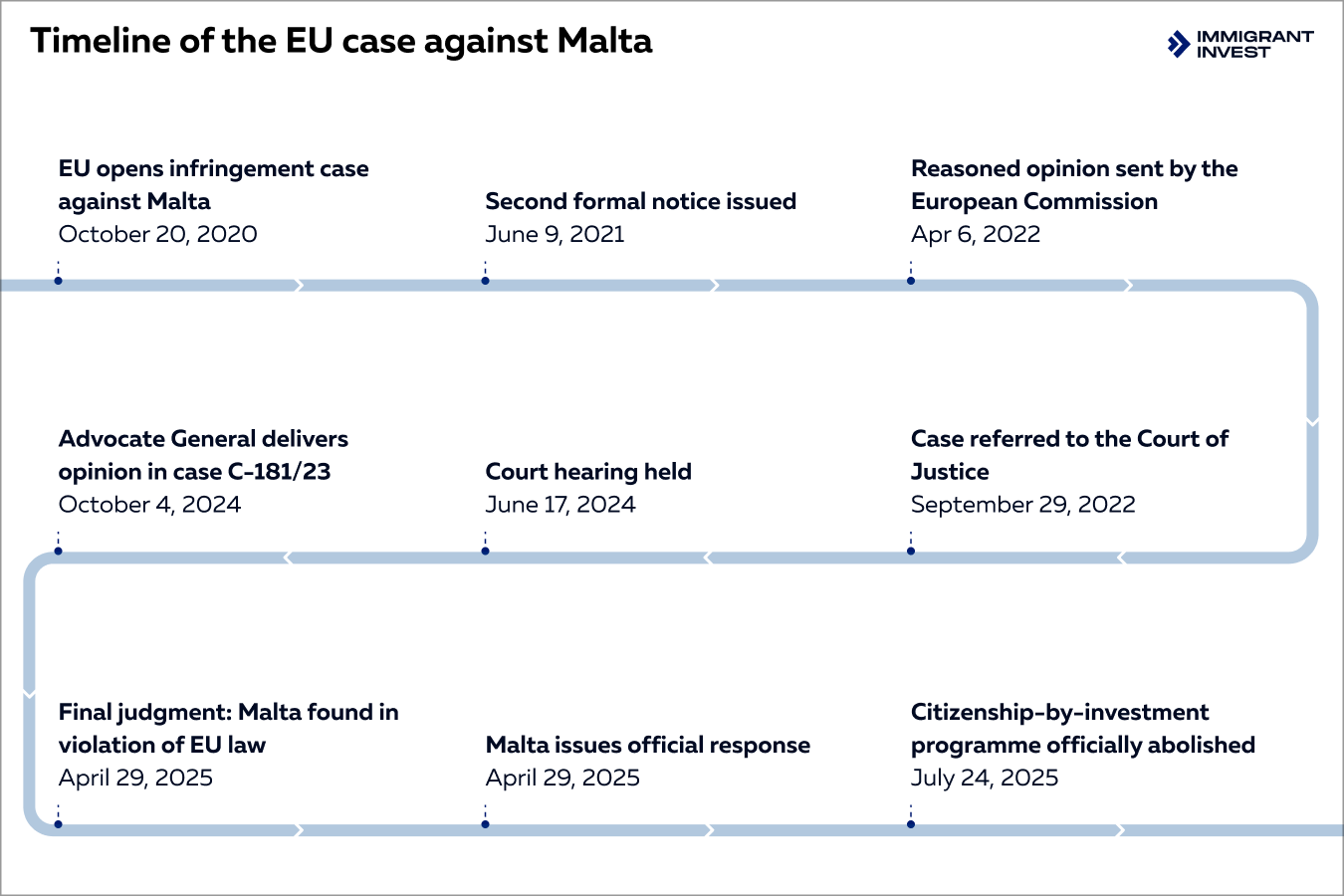
On July 24th, 2025, Malta officially abolished its citizenship for exceptional services by direct investment with the introduction of Act XXI of 2025[1]. This step was taken after sustained pressure from the European Union and a ruling of the Court of Justice, which declared the investment route incompatible with EU law.
Until then, non-EU nationals could acquire Maltese citizenship for exceptional services by direct investment by contributing at least €690,000. That path is no longer available. However, Malta has not closed its doors completely.
Foreign nationals still have the option to settle in the country through the Malta Permanent Residence Programme. It provides long-term residence rights and, over time, the possibility of applying for citizenship through standard procedures.
1. Lack of a genuine tie. The Court ruled that granting citizenship solely based on financial investment was unacceptable, as it did not require a genuine link to Malta through residence or integration. Since Maltese citizenship automatically confers EU citizenship, this practice was deemed unacceptable[3].
2. Erosion of mutual trust. Granting EU rights to individuals without a real connection to a Member State undermines the mutual trust essential for the functioning of key Union systems. This trust is necessary for cooperation on free movement, asylum, and law enforcement.
3. Security and abuse risks. The Court and the European Commission noted that the application process involved only limited checks. This created direct security risks for the Union, as it allowed individuals to obtain EU rights without proper vetting and opened opportunities for abuse[4].
New applicants. It is no longer possible to apply for Maltese citizenship for exceptional services by direct investment. This route has been permanently closed and removed from legislation.
Ongoing applicants. Pending applications have lost their legal basis, as all references to the investment route were deleted from the law. These applicants may need to explore alternative options, such as the regular naturalisation process or the new merit-based pathway, if they qualify.
Agents and advisers. Professionals who previously assisted clients no longer have an official role, since the legal framework that allowed their work has been dismantled.
With Malta’s citizenship for exceptional services by direct investment route now officially closed, attention has shifted to the country’s most advanced residence option.
The Malta Permanent Residence Programme, MPRP, grants lifelong EU residency without requiring relocation to Malta. It provides a secure and flexible solution for investors who want long-term access to Malta and the Schengen Area. After at least 5 years of living in Malta, permanent residents might obtain Maltese citizenship by naturalisation.
The programme is based on a one-time investment, and there is no minimum stay requirement.
Applicants must either rent or purchase residential property in Malta and fulfil additional financial obligations:
Renting property requires a minimum outlay of €169,000, which covers fees, donation, and rent for 5 years. The minimum rental price is €14,000 per year, and the applicant must maintain a residential address in Malta throughout this period.
Purchasing property requires at least €474,000. This includes fees, donation, and the acquisition of real estate worth at least €375,000. The property must be held for a minimum of 5 years. During that time, it can be rented out for short stays when the investor is absent. After 5 years, the property may be sold.
Applications may also include:
The entire family receives the same rights as the main applicant, such as access to healthcare in Malta as well as across other EU countries.
Investor’s children can enrol in Maltese schools and universities, where most programmes are taught in English. They may also join short-term courses throughout the EU without needing a separate student residence permit.
The MPRP is a cornerstone of Malta’s residency and economic strategy. In 2024 alone, according to Home Affairs Minister Byron Camilleri, the programme received more than 1,500 applications, generating:
Based on Immigrant Invest’s experience, the process usually takes around 6 months from the first consultation to receiving the residence cards.
Importantly, the Malta Permanent Residence Programme can only be obtained through a licensed agent. Immigrant Invest is authorised by the Maltese government to represent investors.
We start with an internal review using the same databases as Residency Malta to confirm eligibility and cut the refusal risk to just 1%.
Once cleared, we sign the service agreement and proceed with the application through our role as a licensed agent.
If desired, we can arrange a 1-year temporary residence card while the main application is in progress. You’ll only need to visit Malta once for biometrics, and the card is issued within a few weeks.
At this stage, a €100 fee per temporary card is payable, along with the first instalment of the €15,000 administrative fee.
We shortlist suitable rental or purchase options with trusted local agents, based on your preferences. Our lawyers then review contracts, negotiate terms if necessary, and ensure everything is in order before you commit.
Our lawyers prepare a customised checklist of documents tailored to your family’s situation. The investor collects the basics — passports, certificates, bank statements — while we handle the rest: completing all forms, formatting correctly, and arranging certified translations.
When the file is complete, we submit the full application package to Residency Malta. If no temporary residence permit was requested earlier, the investor pays the first instalment of the €15,000 administrative fee at this stage.
The Residency Malta Agency conducts detailed Due Diligence and may request clarifications during the process. We take care of all communication and prepare the necessary responses, so you don’t have to deal with the paperwork.
Once the checks are complete, the Agency issues either a Letter of Approval in Principle or a rejection notice.
Once your application is approved, we guide you through the final steps: paying the remaining €45,000 administrative fee, making the €2,000 charitable donation, settling the contribution fee, arranging health insurance, and completing your property lease or purchase.
When all requirements are fulfilled, the Residency Malta Agency issues the certificate of permanent residence.
You and your family provide biometrics in Malta. Residence cards are then issued and either couriered to you or collected locally.
For the first 5 years, Residency Malta conducts annual checks to ensure conditions are still met: maintaining a property in Malta and holding the required level of assets. We remind you in advance and help prepare all necessary documents.
Holding a status under the Malta Permanent Residence Programme does not provide a fast-track to citizenship. Investors must follow the same standard naturalisation procedure as any other long-term resident.
Residence period. Applicants must have lived in Malta for at least 5 years in total. This includes 12 months of uninterrupted residence immediately before the application, plus at least 4 years within the previous 6 years[6].
Integration. Applicants must demonstrate knowledge of Maltese or English, familiarity with local civic life, good character, and a sound mind.
Discretionary approval. Citizenship is never automatic. The Minister responsible for citizenship makes the final decision after thorough Due Diligence carried out by the Community Malta Agency.
Applicants are also required to provide references from two Maltese citizens who are not related to them:
Maltese citizenship legislation provides for naturalisation in cases of exceptional merit. This is a discretionary, independent process and is neither a continuation of, nor an alternative to, any former citizenship by investment schemes.
Under this framework, citizenship may be granted to individuals whose activities or achievements represent exceptional services to Malta or to humanity. The legislative provisions recognise contributions across areas such as entrepreneurship, innovation, science, education, culture, philanthropy, and other activities aligned with Malta’s Vision 2050 strategy — a long-term national plan centred on social inclusion, sustainability, and active global engagement[2].
To submit a request for assessment, applicants must have already made — or be clearly positioned to make — exceptional contributions. These may fall into areas such as:
All submissions are reviewed by a dedicated evaluation board, with the final decision resting with the Minister responsible for citizenship.
During a media briefing in Parliament, the Minister for Home Affairs, Security and Employment, Byron Camilleri, explained the new vision: “Anyone who can offer an exceptional service or contribution to our country may submit a proposal. It will be assessed through a rigorous process that evaluates the added value Malta needs, in line with the Malta Vision 2050 we are working toward.”[10]
As the assessment is discretionary, the inclusion of family members depends on the individual case and is determined by the Community Malta Agency.
Rules allow to include to the application:
Requests for naturalisation by merit are assessed strictly on a case-by-case basis at the discretion of the Community Malta Agency. Applicants must demonstrate exceptional merit as defined under the statutory provisions of the Maltese government.
The duration of the assessment process is subject to the administrative requirements of the Agency and the specific circumstances of the case.

Yes, Malta officially closed its citizenship for exceptional services by direct investment route on July 24th, 2025, with the entry into force of Act XXI of 2025.
In Case C-181/23, the Court of Justice of the European Union ruled that Malta’s investor citizenship model breached EU law. The court found it incompatible because it granted EU citizenship without requiring genuine ties to Malta, undermining trust and security within the EU. In response, Malta abolished its investment citizenship for exceptional services by direct investment route.
Citizenship by naturalisation is possible after at least 5 years of legal residence, but it is not automatic. Applicants must show integration, continuous residence, and good character.
The Malta Permanent Residence Programme is a long-term residence programme offering lifelong Maltese residency without requiring continuous presence. Investors must rent or purchase property, pay a contribution and administrative fee, and make a donation. Minimum investment sum under the programme is €169,000.
Yes, but only through a new merit-based route or standard naturalisation. The previous investment-based path is closed, and all applications are now assessed based on genuine ties, merit, or long-term residence.
Yes, the citizenship by investment route is fully shut down as of July 2025. Investors can apply for citizenship through standard naturalisation, which requires 5 years of residence.
Malta allows individuals to submit a request for naturalisation citizenship by merit who provide exceptional services or contributions to Malta or humanity, which may fall within areas such as:
The European Court of Justice, ECJ, ruled that Malta citizenship for exceptional services by direct investment violated EU law by treating citizenship as a commercial product. The court emphasised that EU citizenship must reflect a real link between the person and the Member State. As a result, Malta discontinued its investment route.