Malta offers a more affordable lifestyle compared to many European countries. Consumer prices are 12.4% lower than the EU average and significantly more affordable than in places like Austria, Switzerland, or the US.
But what does this mean for everyday expenses like housing, food, and healthcare? Keep reading to discover the cost of living in Malta and how it compares to other countries.




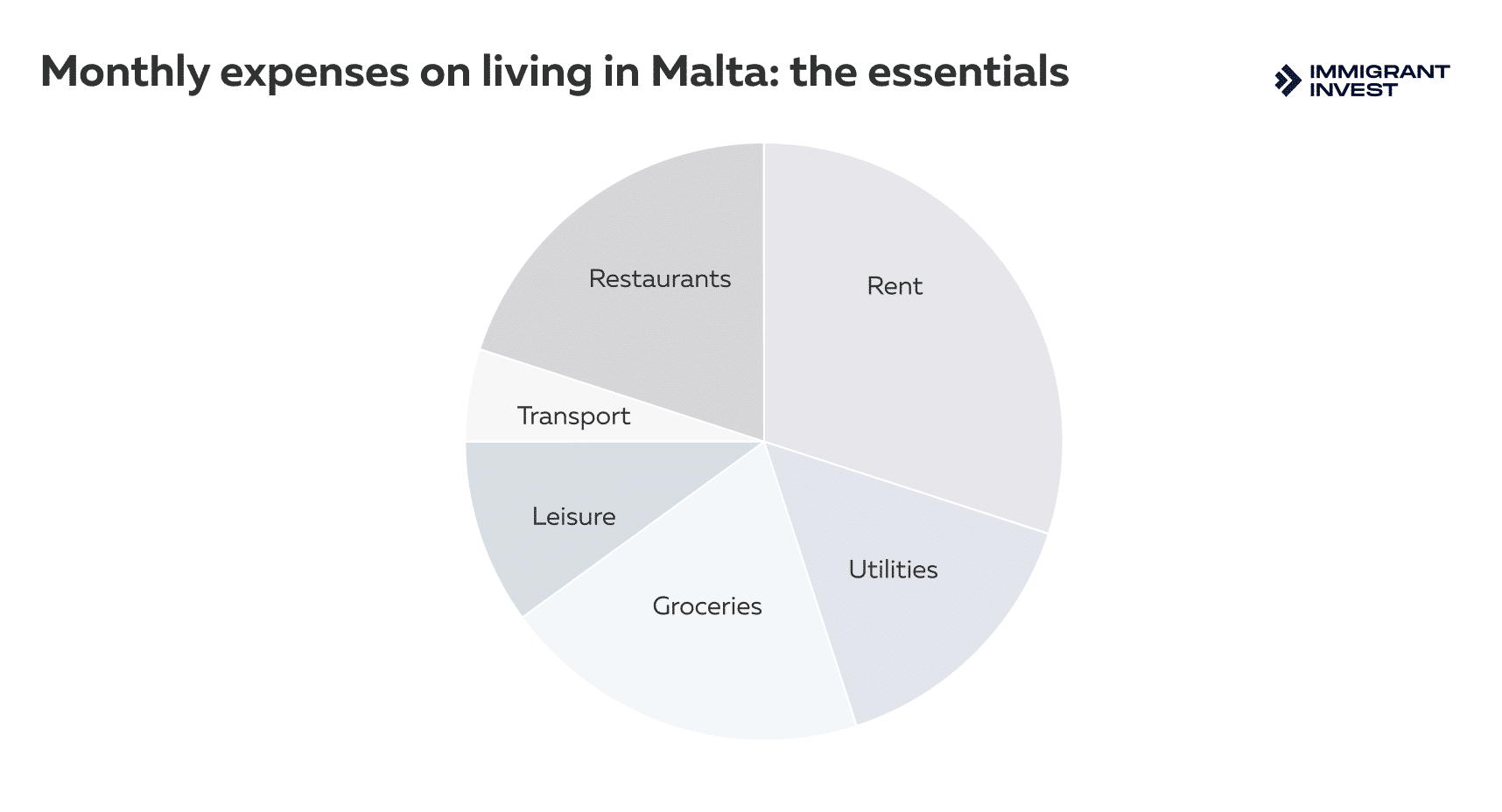
The cost of living in Malta as a foreigner depends on whether one is moving there alone or with a family. For a single person, living expenses typically amount to around €800 per month, while a family of four would need approximately €3,100 each month. These costs include everyday essentials such as electricity, water, healthcare, transport, and food.
Rent varies depending on location and type of accommodation, but it is generally between €810 and 970 for a single person, and €1,280 to 1,650 for a family.
| Expense item | Single person’s expenses | Family’s expenses |
| Rent | €970 | €1,280 |
| Electricity | €90 | €270 |
| Water | €10 | €50 |
| Internet and mobile services | €35 | €55 |
| Healthcare | €50 | €450 |
| Transportation | €50 | €100 |
| Food and groceries | €400 | €1,000 |
| Leisure | €200 | €400 |
| Total | €1,780 | €4,395 |
Housing costs in Malta depend on location, with higher prices in central towns and lower costs in Gozo or the south. Expats can rent or buy property freely, while investors must meet specific requirements to qualify for residency. Monthly expenses also include utilities and internet, which add to the overall cost of living.
Renting a 1-bedroom apartment may cost about €700—1,000 in high-density towns in the north or centre of Malta, like Valletta, St Julian’s, or Sliema.
Prices for renting an apartment are lower in the south of Malta and on the island of Gozo: these areas have less developed infrastructure and tourist flow. Renting a 1-bedroom apartment in Gozo costs €500—700 a month, which is nearly half as much as rentals in Valletta.
Wealthy individuals who obtain Malta residency or citizenship through investment have specific requirements regarding minimum yearly rental prices:
In addition to rental requirements, investors must meet other conditions. For example, one must fulfil additional financial criteria, including a contribution fee of €37,000, an administration fee of €60,000, and a charitable donation of €2,000, to apply for the Malta Permanent Residence Programme.
Buying property in Malta can be a profitable investment: real estate prices have grown by 4—6% annually over the last eight years. However, the process is quite time-consuming: finding property and conducting the deal may take 3—6 months.
Average housing prices range from €2,000 to 8,500 per square metre, depending on the property’s location, condition and other peculiarities.
Expats may buy properties in Special Designated Areas, SDA, without any restrictions. These are usually luxury development projects. If a foreigner buys real estate in Malta outside SDAs, they need to obtain a permit for the acquisition of immovable property. In that case, they can purchase a home in Malta only for themselves but not for renting out.
When buying an apartment or a villa in Malta, one must pay 5% stamp duty and 1.5 to 2% in legal fees. There’s no annual property tax, but a land tax may be levied; it is about €40—250 a year.
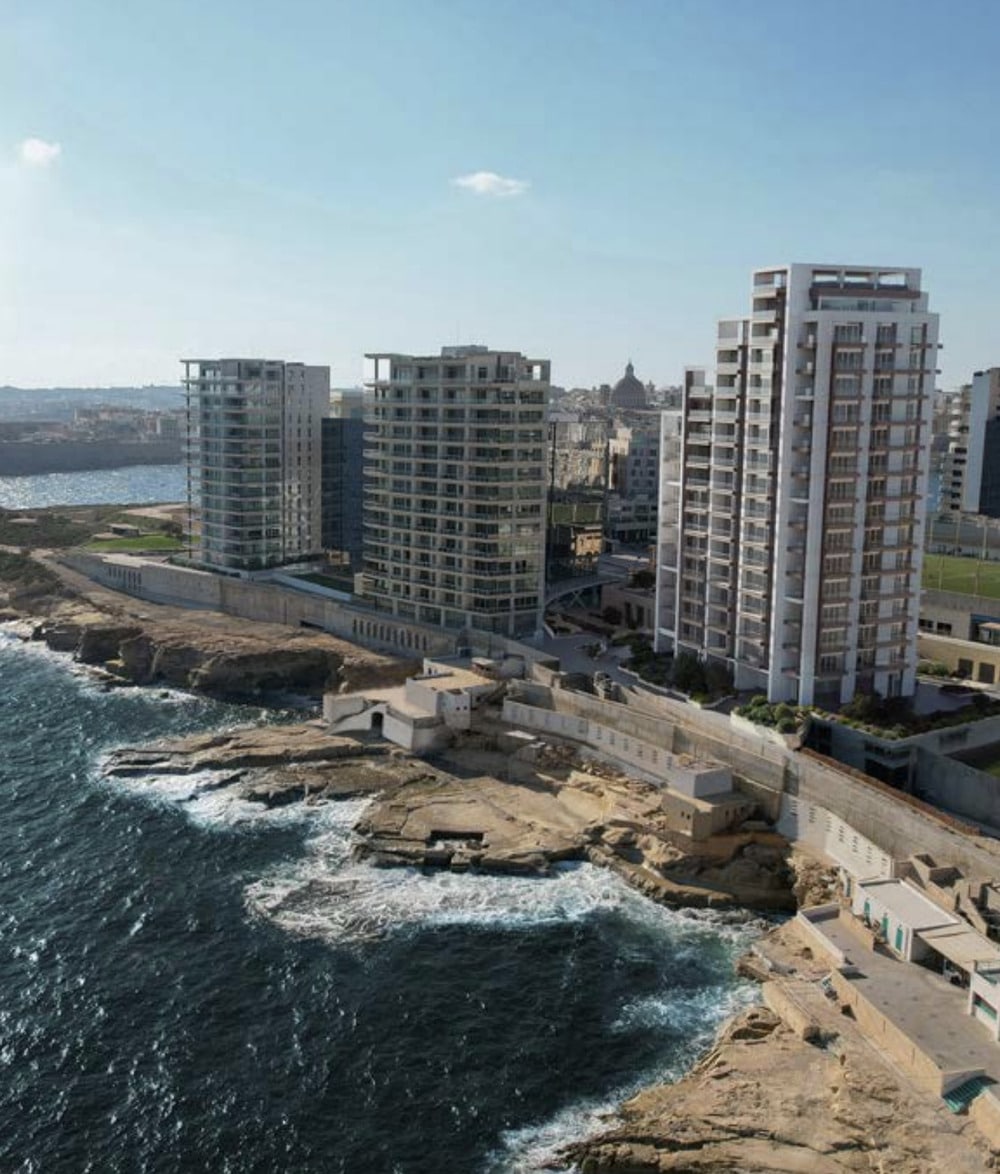
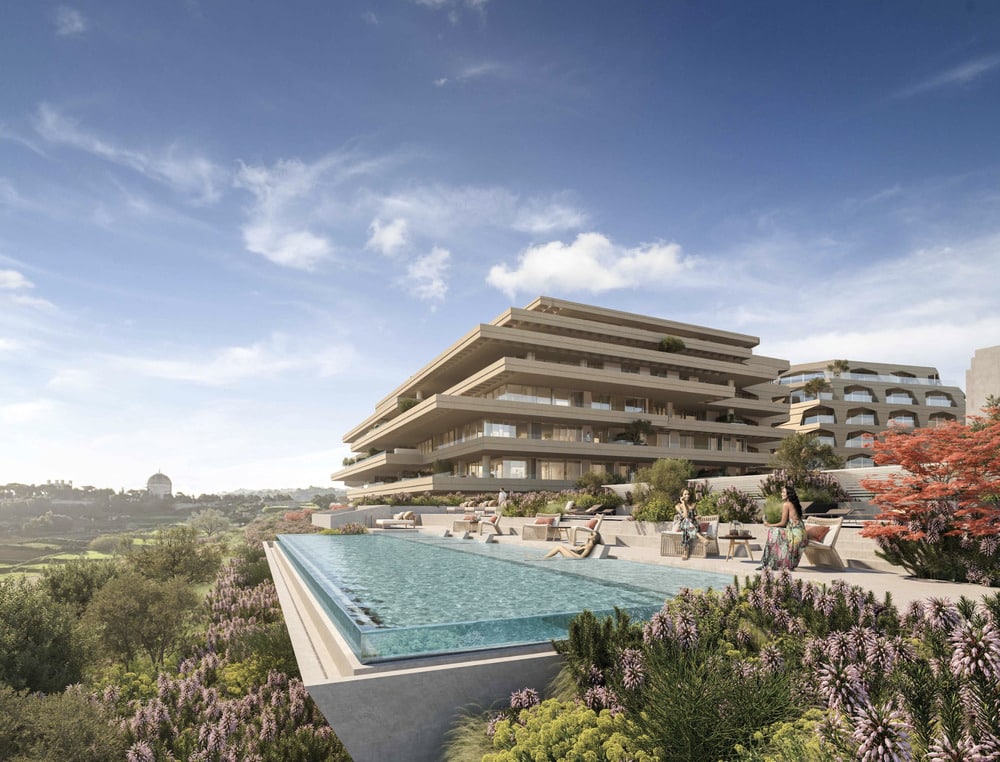
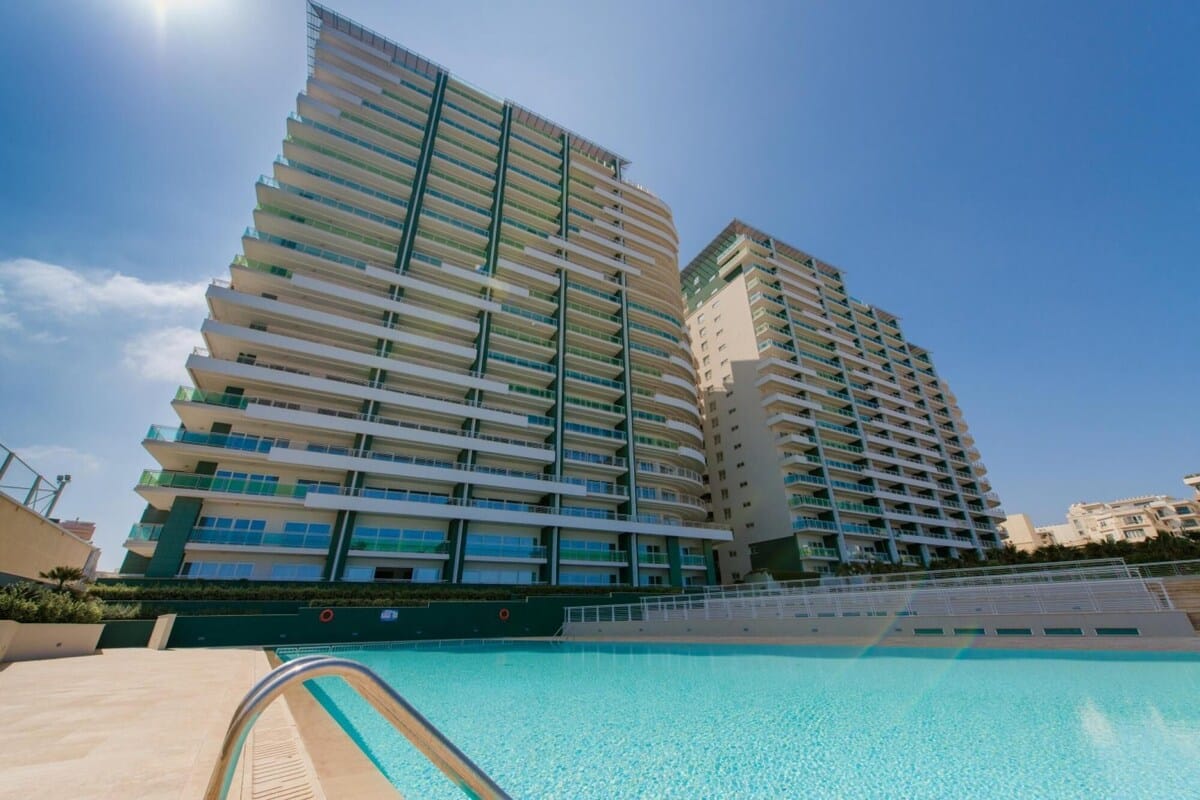
Utilities cost about €150—200 a month for an apartment and may rise to €500—1,000 for a villa or a luxury property in an SDA complex. This amount includes electricity, cold water, and building and plot maintenance.
The electricity tariff is €0.12—0.70 per kWh, depending on the consumption. If you want to charge an electric vehicle at home, you must install a special metre with a fee of €50—80 and pay €4 to 6 for a monthly service charge. Prices on electricity for vehicles are about €0.13 per kWh if you charge them during off-peak times:
Water tariffs also depend on consumption and are €1.40—5.14 per m3 of cold water. There’s no central heating or hot water in Malta, so people use air conditioners and heaters.
The state pays for waste disposal, and residents must separate waste for recycling.
Internet for a home costs €20 to 50 a month, depending on the provider and the speed you need.
Food prices in Malta depend on location and product origin. Groceries and dining out are more expensive in tourist centres like Valletta, St Julian’s, and Sliema, while they are cheaper in quieter areas such as Gozo. Imported goods raise prices for many staples, but locally produced items remain affordable and add a distinct Maltese flavour to the shopping basket.
The cost of food in Malta varies by region. In Valletta, the capital, or other popular tourist towns like St Julian’s or Sliema, the expense for groceries and dining out is significantly higher than in less frequented areas like the island of Gozo.
Fruits, vegetables, and drinking water are more expensive in Malta than in other Southern European countries, such as Italy or Greece. This is due to Malta's rocky terrain, which offers little fertile land and lacks freshwater sources. Consequently, these items are imported from neighbouring Sicily.
Malta produces a variety of local goods, such as olives, citrus fruits, and some vegetables, which can be found in markets and supermarkets. Locally produced food in Malta is usually more affordable due to lower transportation costs and reduced import duties, offering a fresh and unique taste of Malta’s agriculture.
| Product | Price |
| Milk, 1 litre | €1 |
| White bread, 500-gram loaf | €1 |
| Rice, 1 kg | €3 |
| Eggs, dozen | €3 |
| Chicken Fillets, 1 kg | €8 |
| Apples, 1 kg | €3 |
| Oranges, 1 kg | €2 |
| Banana, 1 kg | €2 |
| Tomato, 1 kg | €3 |
| Potato, 1 kg | €2 |
| Onions, 1 kg | €2 |
| Lettuce, 1 head | €2 |
| Drinking water, 1.5 litre | €0.8 |
A can of Coke or a cup of cappuccino costs around €2. Regarding alcohol, a bottle of mid-range wine is about €7, while domestic or imported beer is nearly €4.
Malta's restaurants are worth visiting. The local cuisine is diverse, shaped by the influences of various national traditions. Seafood and fish dominate Maltese dishes, with Italian cuisine also widely available on local menus.
A three-course meal for two in a mid-range restaurant is around €70. For a more sophisticated dining experience, you can visit one of Malta’s Michelin-starred restaurants:
A meal at a Michelin-starred restaurant ranges from €70 to 100 per person.
Malta covers an area of 316 km², making it 80 times smaller than the neighbouring island of Sicily. Everything you need is nearby, and public transport is well-developed.
Bus tickets cost €2.50 during the day and €3.00 at night. Travellers can purchase them directly from bus drivers.
If you travel frequently, a transport card may be more economical than buying individual tickets. There are several types of transport cards available in Malta:
Expats can apply for the Tallinja card online. Non-personalised transport cards are available at ticket offices and some shops.
Children under four travel on buses for free and don’t need a card.
A trip from Valletta to Sliema or from Valletta to Isla and Bormla costs €2.50 for an adult. Holders of personalised Tallinja cards can take ferry rides for free.
While Malta offers affordable public transportation, those with yachts can also benefit from Malta’s attractive yacht registration regime. The country provides substantial tax advantages. The registration fees are relatively low compared to other European countries, and yacht owners can enjoy fewer restrictions on the sale or mortgage of their vessels.
Malta allows yacht ownership by both individuals and companies. Additionally, foreign ownership is possible, with no restrictions on nationality, which opens doors for international yacht investors.

Taxi fares start at around €5 and cost €2 per km. For example, a ride from Valletta to St Julian’s may cost between €19 to €25, depending on the taxi service and the type of vehicle you choose.
Gasoline costs about €1.35 per litre in Malta. Since 2021, the Maltese government has implemented a fixed energy price policy to shield households and businesses from global energy price fluctuations. As a result, the cost of gasoline has not increased significantly in recent years, despite fluctuations in global oil prices.
The life expectancy at birth in Malta is 83 years, which is among the highest in Europe. This is largely attributed to the country's high-quality healthcare system. For comparison, Japan has a life expectancy of 84 years, widely known for its excellent healthcare.
Every foreigner residing in Malta is required to purchase health insurance. For instance, applicants for a Malta permanent residence permit by investment must have insurance that covers at least €30,000 in medical expenses. The cost of such a certificate ranges from €100 to 400, depending on the applicant's health and age.
If insurance is no longer valid or does not cover a specific procedure, the expat must pay out of pocket. A doctor’s appointment costs between €10 and 60, a general blood test around €20, and an ultrasound between €50 and 200.
Maltese citizens, as well as EU citizens residing in Malta, are entitled to necessary treatment for free at public medical facilities and must pay for services in private medical centres.
As Malta is a member of the EU, its citizens also benefit from the European Health Insurance Card, EHIC, which allows them to access necessary medical treatment in other EU countries at the same cost as locally insured individuals.
Schools and kindergartens are typically free for foreign children whose parents have residency and a work permit in Malta. Otherwise, expats pay for education in private facilities.
Preschool and secondary education. A month in a private kindergarten in Malta costs around €400 to 600. Annual tuition at a private school starts at €8,000.
Higher education. Tuition is required for foreigners at all levels of higher education. Annual tuition at Malta's universities typically ranges from €5,000 to 25,000, depending on the field of study and degree obtained. Medical training is generally the most expensive.
Diplomas from Maltese universities are recognised in the EU and several other countries, making it easier for graduates to find employment abroad.
Language courses. Malta is popular among foreigners learning English. A standard 2‑week language course, offering 20 lessons per week, costs between €350 and 500.
Clothing. In mass-market chain stores, a shirt costs about €20 to 40, a pair of jeans or trousers may range from €30 to 80, and dresses vary from €20 to 150, depending on the brand, fabric, and other details.
Footwear. Mid-range sneakers or business shoes usually start at around €80.
Fitness. The monthly fee for attending a gym or fitness club in Malta is €60 to 100, depending on the club and the terms of your membership.
Leisure time. A cinema ticket for an adult costs about €9, while a family pass starts at €20. Tickets for children are cheaper.
Yachting, a popular leisure activity in Malta, can vary greatly in cost. Renting a yacht or a motorboat for a day ranges from €30 to 1,500. Malta is also a renowned location for diving; a beginner’s course costs between €40 and 500, depending on its duration and program.
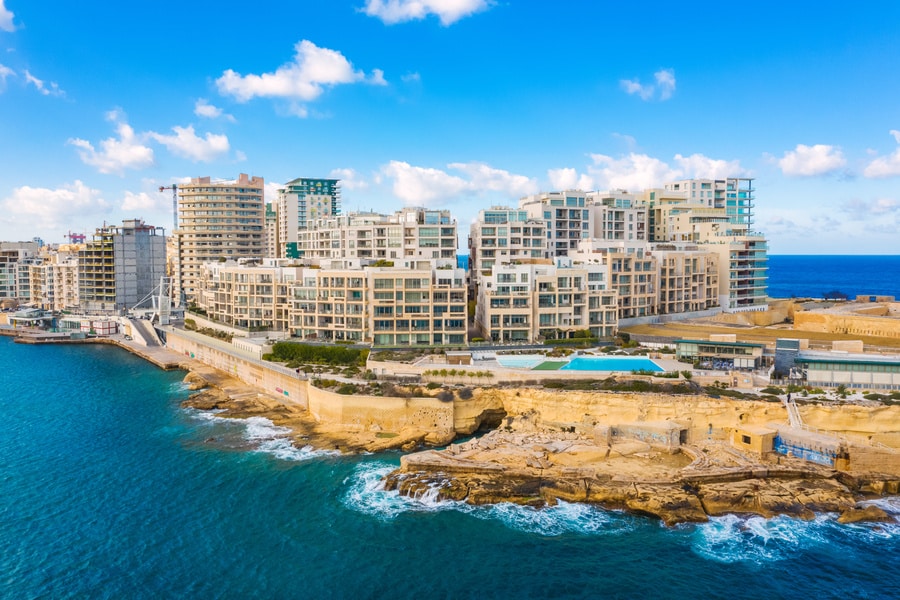
Before deciding whether living in Malta is affordable, one should compare it with other European states.
According to Eurostat, overall consumer prices in Malta are lower than in Cyprus, Germany, Austria, France and some other EU countries. Some goods may be more expensive in Malta than in other Southern European countries, but living in Malta is more affordable than in most states of Eastern and Northern Europe.
To live in Malta, a family of four needs about €3,100 a month, excluding rent, and €800 may cover the expenses of a single person.
Consumer prices in Malta are quite stable, as stated by Eurostat. By December 2024, Malta had experienced a 15% increase in prices relative to 2015, which is lower than in some other European countries, including Norway and Germany.
Life in Malta is around 40% cheaper than in the US. In Malta, monthly expenses for a person with a moderate lifestyle do not exceed €800, while in the US, one would need more than €1,200 for a similar lifestyle.
| Item | Malta | Spain | | | |
| Milk, 1 litre | €1 | €1 | €1 | €2 | €1 |
| A loaf of | €1 | €1 | €2 | €3 | €3 |
| Eggs, a | €3 | €2.50 | €3 | €4 | €4 |
| Apples, 1 kg | €3 | €2 | €3 | €3 | €5 |
| Meal for two in a | €70 | €50 | €65 | €90 | €70 |
| €977 | €937 | €887 | €1,607 | ||
| Buying an | €3,581 | €5,555 | €5,026 | €2,983 | |
| Basic utilities per month | €90 | €130 | €300 | €200 | €190 |
| €26 | €30 | €50 | €80 | €60 | |
| Taxi, 1 km | €2 | €1.30 | €2.50 | €2 | €1.60 |
To live in Malta, one needs an official status: a residence permit or citizenship. Investors can obtain these if they contribute to the country’s economy; some of their family members can also be included in the applications.
A Malta residence permit may be granted to an investor under the Global Residence Programme. An applicant must rent housing for at least €8,750 annually or buy a property for €220,000, and pay an administrative fee of €5,500 or €6,000, depending on the property’s location.
After obtaining a residence permit, investors start paying taxes under the special regime:
Residence permit holders are not required to live in Malta but must spend fewer than 183 days a year in any other country to maintain residency.
Malta permanent residency by investment is obtained under the Malta Permanent Residence Programme. This route allows one to get a Malta PR card within several months: the application processing time is 4—6 months, and some additional time is needed to prepare all necessary documents.
As part of the investment, applicants must either buy housing in Malta or commit to at least 5 years of rent. The required minimal investments are:
In addition, an investor pays:
Applicants must also demonstrate ownership of capital assets to qualify. There are two options to meet this requirement:
Malta PR is a lifelong status that allows one to live in Malta and travel within the Schengen Area for 90 days within any 180-day period.
There is no investment-based path to Malta citizenship. Maltese nationality legislation provides for the possibility of naturalisation in cases of exceptional merit.
The statutory framework recognises exceptional contributions across various areas, such as entrepreneurship, job creation, innovation, science, education, culture, or philanthropy.
Malta citizenship can be obtained by naturalisation for exceptional services by direct investment. This path includes naturalisation after one or three years of residency, depending on investment specifics.
An applicant fulfils several investment conditions:
A Malta passport allows one to travel to 169 countries visa-free, live in Malta or reside in another EU country, and give their family easy access to high-quality education or healthcare.
Investors and their family members obtain a Malta residence permit and can apply for citizenship one or three years later, depending on the investment amount. Additional documents are required after three years of residency, but the process remains generally the same.
The entire process of obtaining a passport takes about two to four years, depending on the chosen option. Immigrant Invest holds a licence from the Maltese Government, allowing the company’s lawyers to act on the investor’s behalf when applying for citizenship by naturalisation for exceptional services by direct investment.
Immigrant Invest’s certified Anti‑Money Laundering Officers conduct preliminary Due Diligence on each applicant. They review documents and check international databases to identify potential risks.
This review enhances the applicant’s chances of success, decreasing the likelihood of rejection to 1%.
The Community Malta Agency carries out background checks of all applicants over 12 years old in the Europol and Interpol databases. Once the check is complete, the process of preparing the citizenship application can continue.
All individuals over 18 apply for a Malta residence permit. Children may be included in the application at the parents’ discretion.
Our lawyers assist applicants with finding rental accommodation, arranging health insurance, and managing all necessary paperwork. The investor and their family members then travel to Malta for fingerprinting and to submit their residency applications.
Residency cards are issued within two weeks and are valid for three years, with the possibility of an extension if further time is required to complete the citizenship process.
The application for the Eligibility Assessment must be submitted within 12 months after receiving Malta residence permit cards and accompanied by a full set of documents.
Immigrant Invest lawyers provide a full list of required documents. They complete government forms, assist with the welfare history, prepare necessary affidavits, as well as translate, apostille, and notarise the documents. The document collection process takes at least two weeks.
The Eligibility Assessment takes 4—5 months. Following this, the Minister responsible for Malta citizenship matters will approve the application.
If the application is submitted after one year, the investor adds an affidavit confirming that their circumstances have not changed. If there have been changes, an additional affidavit and specific forms are required.
If the investor applies for citizenship after three years of residence, updated documents and certificates must be submitted.
The Minister grants final approval and issues a Letter of Approval, allowing the investor to obtain Malta citizenship.
The investor meets all investment requirements within four months and provides documents confirming their residence in Malta.
Applicants aged 18 or older visit the Agency’s office in Malta to take the oath of allegiance within six months of receiving final approval from the Minister.
Once the oath is taken, applicants over 12 must provide their biometrics. Passports are issued within 4 business days.
Children under 6 do not have to visit Malta.
For the first five years after citizenship approval, Immigrant Invest, as a licensed agent, is required to submit an annual report to the Agency, verifying the investor’s compliance with all obligations. Reporting begins one year after citizenship is granted.
Life in Malta is quite affordable compared to the US, the UK, and some other European countries, such as Germany, Switzerland, Norway, or Denmark.
The cost of living for an expat in Malta depends on family composition and whether you own property. To live in Malta, a family of four needs about €3,100 a month, excluding rent, and a single person may expect to pay at least €800 per month without rent.
Renting a 1-bedroom apartment may cost about €700—1,000 in high‑density towns in the north or centre of Malta, and renting similar housing in Gozo is €500—700.
The average wage in Malta is about €20,500 a year, according to data from the National Statistics Office.
A good salary in Malta depends on the lifestyle and personal circumstances, but generally, a salary of around €2,000 to 3,000 per month after tax is considered a comfortable income for a single person. This would cover living expenses such as rent, utilities, food, transportation, and leisure, with some room for savings or discretionary spending.
For families, a good salary would typically be €4,000 to €5,000 per month, depending on the number of family members and the standard of living desired.
Malta’s income tax is levied at a progressive scale from 0 to 35%. The tax rate depends on the income amount, marital status, and whether the person is a Malta tax resident.
There’s no annual property tax in Malta. Land tax may be levied, ranging from €40 to 250 a year.
Average housing prices range from €2,000 to 8,500 per square metre. The price varies significantly based on location; for example, a square meter in the center of Valletta costs €8,350 on average, and in Gozo, it costs €1,500.
The most convenient way to immigrate to Malta is through residency by investment. The Malta Permanent Residence Programme allows one to obtain Malta PR, a lifelong status, typically within 4 to 6 months. Investors can also apply for a residence permit with a special tax regime.
A foreigner needs a Malta residence permit, housing and sufficient funds for living — about €800 per person per month, excluding rentals.
Living in Malta offers several benefits:
A single person should expect to spend at least €800 for a one‑bedroom apartment outside city centres. The rent in the city centre can start at €1000 per one-bedroom apartment. In Gozo, renting a 1‑bedroom apartment costs €500 to 650 a month, nearly half as much as in Valletta. Families usually pay at least €1,200 for a three‑bedroom apartment.
Malta is an excellent destination for expats, often referred to as the “Mediterranean pearl,” known for its picturesque beaches that offer a tranquil escape from big cities.
The country is expat-friendly. Although Maltese is the official language, most of the population speaks English fluently, ensuring that foreigners do not feel out of place.
Many choose Malta for its favourable tax policy. Income tax for individuals ranges from 0 to 35%, depending on one’s income and marital status. For instance, a single person earning €9,100 a year or less pays no income tax. However, married individuals earning more than €60,000 per year are subject to the highest tax rate: 35%.
Everyday expenses such as food, utilities, and rent are generally lower in Malta compared to the US, with rents being significantly cheaper.
On average, the price of a square meter in an apartment in a city centre in Malta is around €3,581. For €300,000, a buyer can purchase modern, ready‑to‑move‑in apartments in a prestigious residential complex close to the sea.