



The University of Malta is included in the ranking of the best universities in the world and trains specialists in various fields — from IT to art history.
Malta issues international diplomas with which you can work in the US and Europe.
We tell you how to get permanent residence or citizenship of Malta to study in the country for free.
Higher education in Malta: how it works
Malta is attractive for higher education because it combines high-quality education, a safe and welcoming environment, and cost.
In Malta, there are two categories of higher education institutions:
- Universities. The University of Malta and the American University of Malta are the best educational institutions in the country.
- Colleges, including the Mediterranean Institute of Management, the Institute of Tourist Studies, and the Malta College of Arts, Science, and Technology (MCAST).
There are public and private universities in Malta. The largest university, L-Università ta’ Malta, or the University of Malta, is one of the thousand best educational institutions in the world.
Students also study at affiliated universities in the US and the UK, such as the London School of Commerce or Queen Mary University of London. Branch diplomas are issued by the head university. If a student graduates from a Maltese branch of a British university, his diploma will be valid in the UK.
Higher education in Malta is organised according to the principles of the Bologna system. Students can earn several academic degrees:
- Bachelor or Undergraduate. A bachelor’s degree is issued after three years of full-time study. Distance learning lasts longer — from five years.
- Master or Postgraduate. You can become a master in one or two years. The degree is received by those who defended the final work in the speciality: project, monograph or scientific research. For example, students of architecture may prepare a layout of a building.
- Doctor, or PhD. Doctoral students study for two years. During this time, students write and defend a dissertation.
Graduates of local schools and foreigners can enter Malta universities. Citizens of countries outside the European Union receive a student residence permit for study. Children of Malta residents can also study in the country if they have received a residence permit in Malta by investing together with their parents.
The academic year at the Malta universities consists of two semesters. The first lasts from October to mid-December, and the second — from early February to June.
Students go on holiday twice: Christmas in December and Easter in April. During the holidays, international students often travel, including around Europe. The Maltese residence permit replaces the Schengen visa.
7 benefits of higher education in Malta
1. Low cost of education. Education in Malta is, on average, cheaper than in other European countries. For example, studying at the Faculty of Humanities in France or Germany costs €10,000 per year, in Malta — from €3,000.
2. Teaching in English. To enter a university in Malta, you must provide an IELTS certificate. The minimum passing score for short-term courses is usually 4.5 points, for undergraduate programs — 5.0, and for master’s programs — 6.0.
3. The prospect of obtaining Malta citizenship. Students who have studied in Malta for at least six years and have lived there for four years can apply for citizenship by naturalisation. To obtain a passport, you must stay in Malta for a year before applying and pass an English and Maltese exam.
4. Availability of student exchange programs. The University of Malta is a member of the Erasmus + program, in which students can study in another country for a year or a semester. The list of program participants includes the EU countries, Liechtenstein, Iceland, Norway, North Macedonia, Serbia and Turkey.
5. The opportunity to take preparatory courses before admission. Foundation Studies is an annual course in which applicants learn English to the level required for access and deepen their knowledge of core subjects. Such a course can be taken at the University of Malta. You can also learn English in one of the language schools in Malta.
6. Diplomas from Maltese universities are recognised all over the world. A graduate can work in another country — for example, in Europe, the USA or Australia, and he will not need to confirm his diploma in these countries.
7. Opportunity to work while studying. Students of courses lasting more than 90 days are entitled to work 20 hours a week. You can get a job after three months of training. To do this, students apply for a licence to work immediately after obtaining a residence permit. The Jobsplus centre handles work for students.
Disadvantages of Higher Education in Malta
Prices for rooms in student dormitories and utilities are usually high. Since electricity is expensive in the country, there is no fresh water and central heating, and a room on the University of Malta campus costs €3,200 per year.
Often, additional costs for training, such as the purchase of textbooks or experiments, are not included in the tuition fee. Such fees can range from €500 to €20,000 annually and up to €56,000 in medical specialities.
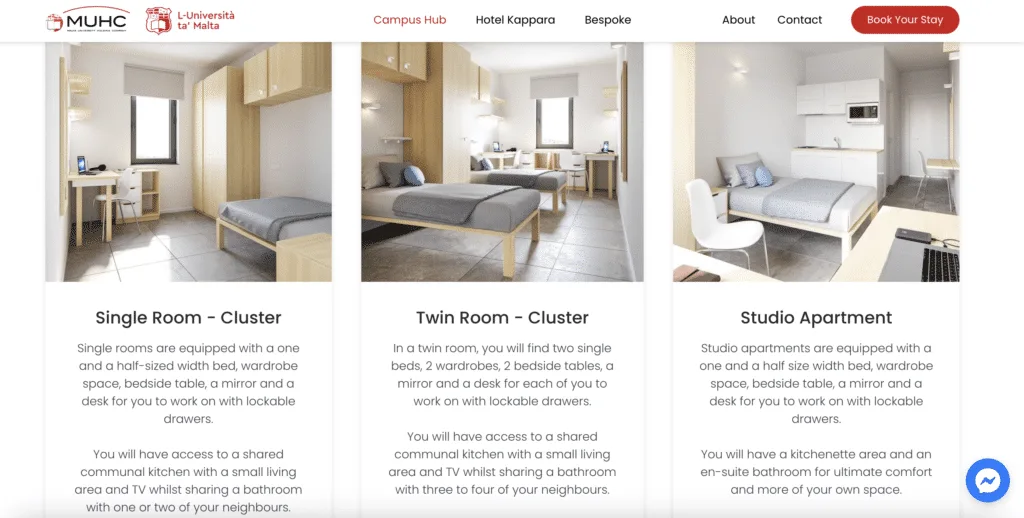
The Malta universities and colleges offer three accommodation options for students: in a hostel on campus, in a hotel ora host family. In the photo — dorm rooms for one or two people
Malta university fees for international and local students
Tuition prices depend on the citizenship of the applicant:
- citizens of Malta and foreigners with a residence permit study for free;
- EU citizens study free of charge or at reduced prices;
- students from countries not members of the European Union pay full tuition.
For a foreigner without a residence permit, a bachelor’s program in the field of humanities will cost €5,000 per year, and for a resident with permanent residence — from €2,000.
The highest prices are on medical programs: a year of study as a general practitioner at the University of Malta costs €20,000. The cheapest way to study is in the humanities and areas related to art and media: on average, tuition costs from €3,000.
Some specialities require additional expenses, such as research activities. Such payments range from €500 per year.
For academic excellence, students qualify for the GET Qualified Scholarship. The scholarship helps cover up to 70% of the cost of tuition and exams.
Top 5 colleges and universities in Malta
1. University of Malta. One of the oldest universities in Europe and the most popular state university in the country, it is included in the QS World University Ranking. The university teaches in English.
Campuses are located throughout the country: in Valletta, Msida, Marsaxlokk and Gozo.
The university trains specialists in various popular areas, such as programmers and lawyers. Also, at the university, you can study computer games or space and languages — Maltese, English, Spanish and others.
The University of Malta has 14 faculties, 18 research institutes, 13 research centres and three schools. The university’s pride is the university library, which stores more than a million sources in various fields.
The cost of studying at the leading university in Malta depends on the chosen speciality and starts from €8,500 per year.
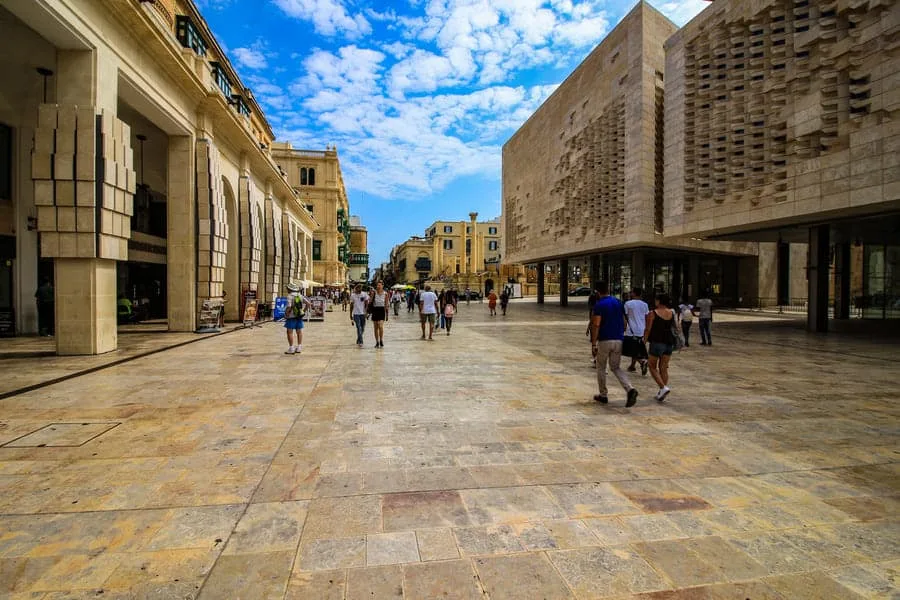
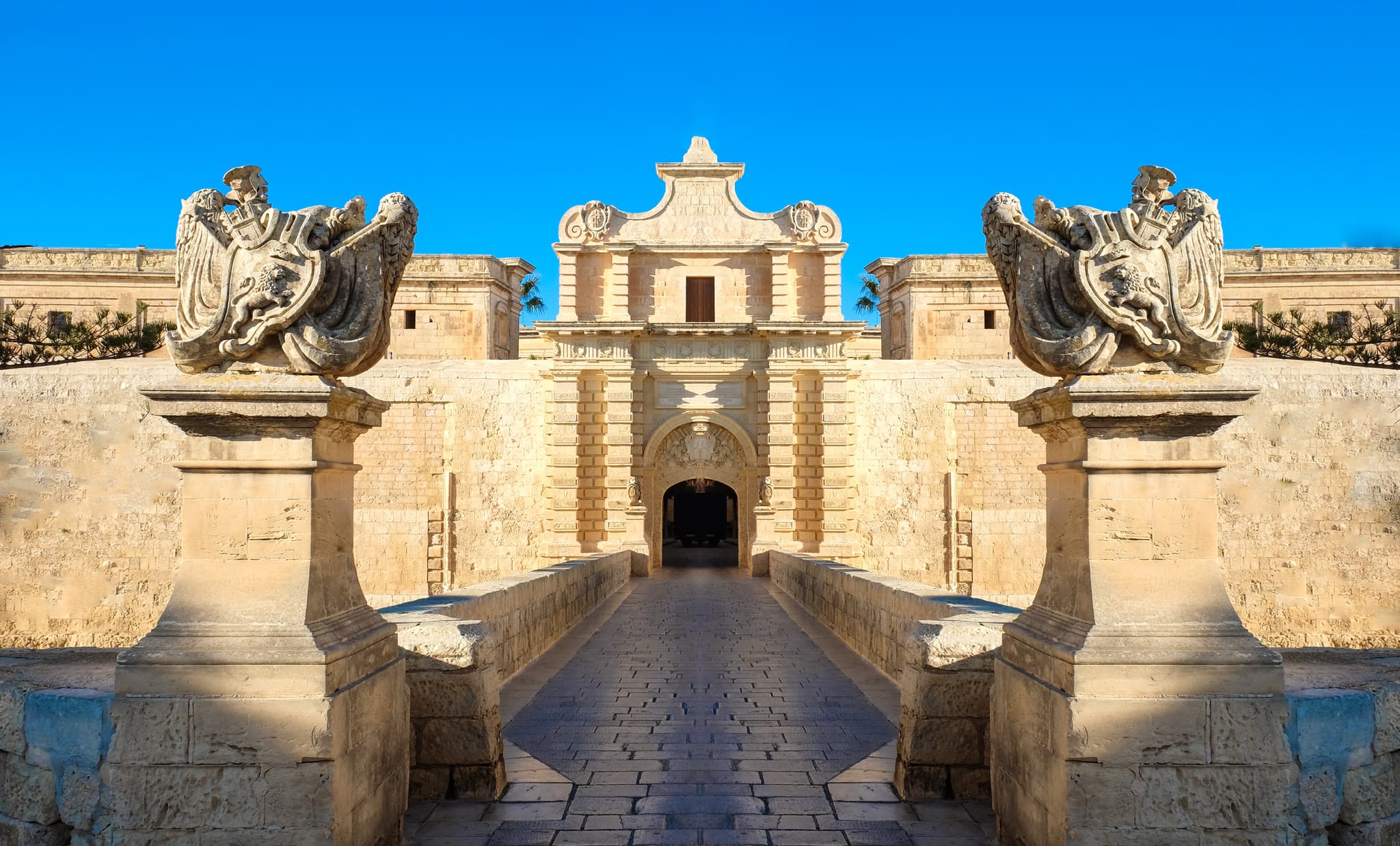
One of the campuses of the University of Malta is located in the capital of the country, Valletta. Ancient castles surround it, and you can walk to the Mediterranean Sea from the campus in 10 minutes
2. Malta College of Arts, Science and Technology, MCAST. The State College trains engineers, doctors, industrial designers, business managers and oil and gas workers. In total, the university has 180 daytime and 300 evening programs. A college education costs €5,400 per year; classes are conducted in English and Maltese.
3. Institute of Tourism Studies. The university specialises in the hotel and restaurant business and trains event organisers, chefs, managers and guides. Malta is a popular international tourism destination, so students also study foreign languages.
The curriculum for the university was developed jointly with the Emirates Academy of Hospitality Management, located in Dubai. It is one of the best educational institutions in the field of tourism.
The cost of education for international students is from €3,200 per year. They teach at the institute in English.
4. Queen Mary, University of London. The branch of the British educational institution in Malta is a leading research centre. The university’s history is connected with the first medical school in England, The London Hospital Medical College.
The university is part of the prestigious Russell Group of UK universities. In the 2023 Times Higher Education (THE) World University Rankings, Queen Mary University of London is ranked 16th in the UK and 124th globally.
More than 30,000 students study at the University of London in Malta, 41% are foreigners.
The most popular areas of the university are dentistry and biology. The cost of studying in medical programs usually depends on the level of study and ranges from €20,000 per year.
5. The American University of Malta was founded in 2016 in Bormla on the model of American higher education institutions. The university offers 10 undergraduate and 3 master’s programs in business, engineering, technology and the arts.
The cost of studying at the American University of Malta for international students is €5,000 per year. Applicants also pay a fee of €1,000.
University students can receive a GET Qualified scholarship and a scholarship of €750 for recommending the university to their friends or relatives.
Trusted by 10,000+ investors
Check your eligibility for Malta permanent residence
What documents are needed for admission to a Malta university
Documents to be submitted by the applicant along with the application:
- Scan of a foreign passport.
- Scan of the certificate of secondary education.
- A copy of the bachelor's degree — for admission to master's programs. An extract with a list of subjects and the number of academic hours is attached to a copy of the diploma. Such an extract is usually issued in Russian universities along with a diploma.
- A certificate confirming the level of English. Having level B1 — IELTS 4.5, TOEFL 80 or Cambridge B1 Preliminary for short courses. Master's programs have a higher level — IELTS 6.0, TOEFL 95 or Cambridge CAE. The Cambridge certificate is valid indefinitely, and IELTS and TOEFL are taken no later than two years before admission.
- Information about financial solvency. Foreigners study in Malta only for a fee. They confirm the availability of funds for living in the country during the entire study period and pay for the course. On average, one academic year on a bachelor's program in Malta costs €13,000; on a master’s program — €14,000.
- Certificate with the results of a medical examination. It will be needed for those who enter sports areas.
All documents are translated into English. Foreign applicants certify scans, copies and translations of documents.
Students must put an apostille on diplomas and certificates issued in other countries. You can apply for an apostille and pay the fee on the public services portal. Still, the original document is handed over and collected from the department or local public services centre only in person. You do not need to certify a certificate or diploma at the consulate.
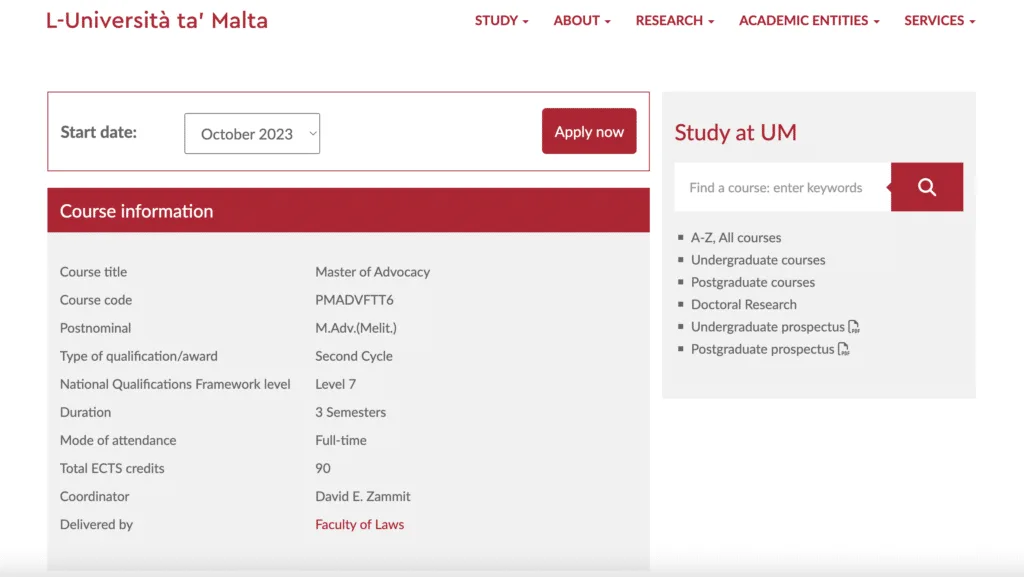
On the University of Malta website, you can find out about all the programs of the university. For each direction, the form of study, mode of attendance, and duration of the course are indicated
How to apply to Maltese universities and colleges
To enter a university, you need to pass a competitive selection. Universities publish in advance the number of available places for each direction and the requirements for applicants online.
Each educational institution also publishes the deadline for submitting documents on its website. Usually, records begin to be accepted in the fall, a year before the start of training, and the competition is closed at the end of July. For example, in the 2023 academic year, the University of Malta accepted applications from international applicants until July 20.
1 day
Apply for admission online
You need to apply for admission to a university in Malta on the website of the selected university. Applicants choose a speciality in advance and indicate it in the application.
You need to apply for admission to a university in Malta on the website of the selected university. Applicants choose a speciality in advance and indicate it in the application.
1 day
Pay application fee
Applicants pay a non-refundable application fee. Citizens and residents of Malta pay €23, while international students pay €95. If you miss the application deadline, the cost will increase to €125.
Applicants pay a non-refundable application fee. Citizens and residents of Malta pay €23, while international students pay €95. If you miss the application deadline, the cost will increase to €125.
1 day
Pass tests
For admission to arts majors, students are asked to take entrance tests, such as music auditions. And to study in the direction of “Sports and Exercise” or “Dancing”, you must pass a medical examination.
For admission to arts majors, students are asked to take entrance tests, such as music auditions. And to study in the direction of “Sports and Exercise” or “Dancing”, you must pass a medical examination.
2 weeks
Get approval
The university informs the applicant about the successful passing of the exams by e-mail or in a personal account on the university website.
The university informs the applicant about the successful passing of the exams by e-mail or in a personal account on the university website.
2 weeks
Obtain a student visa
It would be best to have a student visa to study in Malta. Students receive a C visa if the course lasts less than three months. To survey on periods lasting more than three months, you need a long-term visa D. Such a visa costs €100 and entitles you to obtain a student residence permit upon arrival in Malta. The university helps to extend the status.
It would be best to have a student visa to study in Malta. Students receive a C visa if the course lasts less than three months. To survey on periods lasting more than three months, you need a long-term visa D. Such a visa costs €100 and entitles you to obtain a student residence permit upon arrival in Malta. The university helps to extend the status.
How to study for free in Malta and the EU countries
A Maltese residence permit or passport helps children of foreigners study in Europe for free. You can become a resident for investment.
Obtain permanent status under the Malta Permanent Residence Programme. The investor buys or rents a property for five years, pays government fees and makes donations. He also confirms having assets of at least €500,000, where €150,000 are liquid financial assets. The minimum investment is €150,000.
With the investor, permanent residence can be obtained by his spouse and children of any age if they are unmarried and financially dependent on the applicant.
Become a citizen of Malta by naturalisation. You must continuously live in the country for five years to do this. Investors receive a passport within one or three years if they apply for Malta citizenship for exceptional services by direct investment.
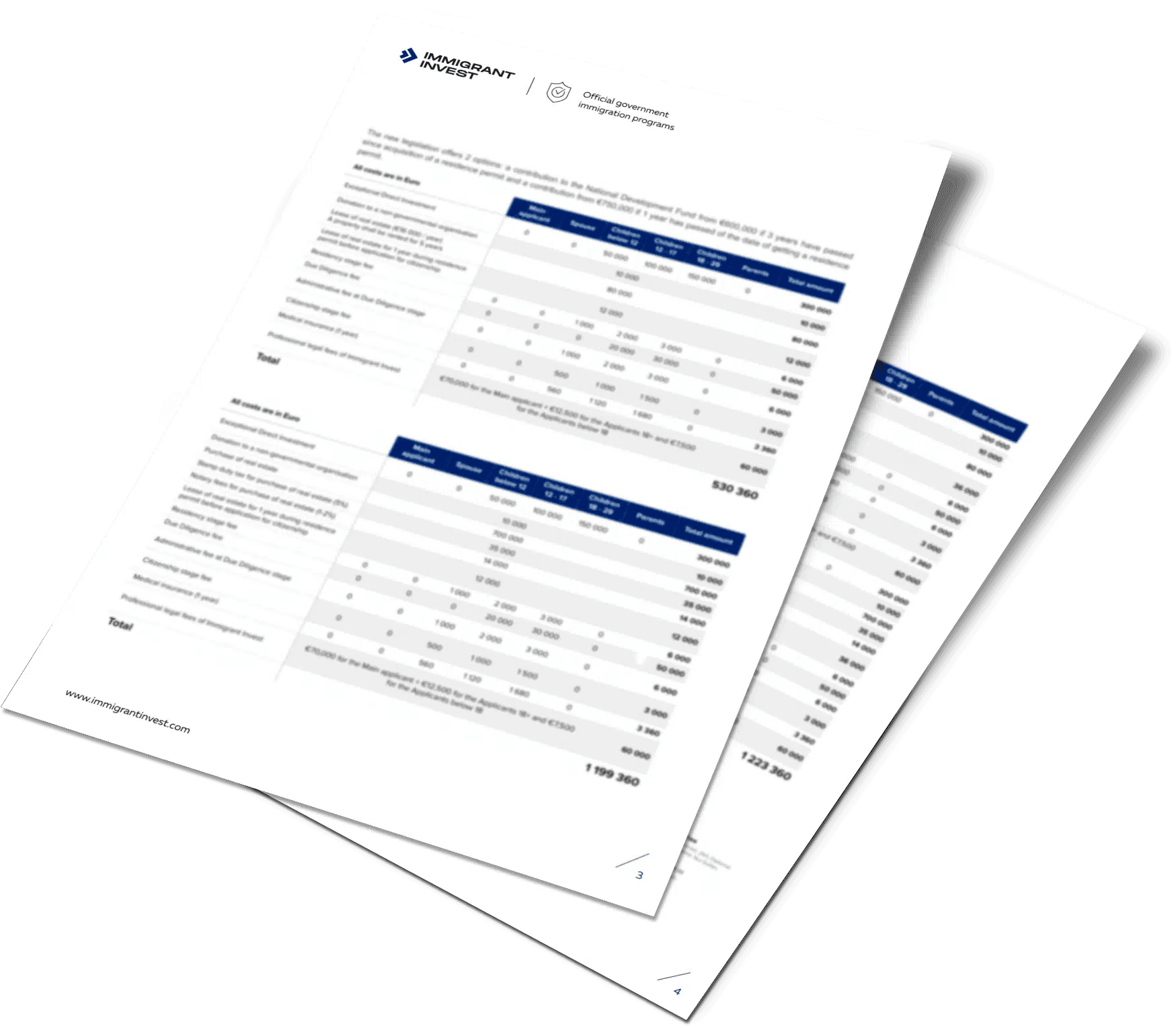
The minimum investment for obtaining citizenship for exceptional services by direct investment is €690,000, and the applicant must:
- Contribute to the Malta National Development and Social Fund of $600,000+.
- Rent real estate for 5 years for €16,000 annually or purchase one for €700,000.
- Makes a charitable donation of $10,000.
Five years after obtaining a passport, the property can be sold.
The application can include a spouse, mainly dependent unmarried children under 29, and principally dependent parents and grandparents over 55.
Checklist: How to apply to the best universities in Malta
- Malta has two categories of higher education institutions: universities and colleges.
- Foreigners can enter one of the universities in Malta: public, private or a branch of a foreign university. The most famous public university in the country is the University of Malta. It is included in the rankings of the best universities in the world.
- Citizens of countries outside the European Union pay tuition from €1,600 per semester. The investor’s children can study in the country for free if the family obtains a residence permit or Malta citizenship for exceptional services by direct investment.
- Diplomas from Maltese universities are quoted worldwide, for example, in Europe, the UK and the USA.
- The universities in Malta teach in English. You must provide an IELTS, TOEFL or Cambridge certificate for admission.
- Students receive a residence permit in Malta. The university helps to extend the status.
 Trusted by 10,000+ investors