Malta Permanent Residence Programme allows foreigners to obtain permanent residency in exchange for investment. The minimum sum is €169,000. This amount covers expenses for renting housing for at least 5 years, paying the state fee, and making a charitable donation.
Alternatively, applicants may choose to purchase a property instead of renting, which starts at €474,000.
In this article, we provide a detailed guide on all requirements, expenses, and procedures for obtaining Malta permanent residence by investment.




Malta Permanent Residence Programme, or MPRP, is a government initiative that allows non-EU and non-EEA nationals to obtain permanent resident status by investing in the country’s economy. The whole process takes 6 or more months.
Launched in 2016, the MPRP is regulated by the Malta Permanent Residence Programme Regulations, L.N. 121 of 2021[1].
Under the MPRP, applicants must fulfil several mandatory requirements:
Investors participating in the MPRP obtain life-long permanent residency and enjoy all the rights of Maltese residents. They only need to renew their residency card every five years.
Many expats pursue permanent residence in Malta because it combines practical mobility with long-term security. The status allows them to travel freely within Europe, settle in a stable country, and access opportunities for business, healthcare, and education.
Maltese residents can enter 29 Schengen Area states without a visa. They can stay in all these countries for up to 90 days within a 180-day period. This makes it easy to travel for business, leisure, or visiting family without dealing with lengthy visa procedures.
Permanent residents can move to Malta anytime, even if borders are closed to foreigners. This is especially beneficial during periods of instability in their other country of residency.
Malta offers a pleasant Mediterranean climate, a high standard of living, and a safe, family-friendly environment. One of the country’s official languages is English, easing interactions with locals and government institutions.
Permanent residents can open companies and run businesses in Malta. Malta provides a stable political environment, a growing economy, and access to the EU single market.
Companies in Malta are taxed at 35%. However, as a benefit, shareholders can receive a refund of part or all of the tax paid when dividends are distributed, reducing their corporate tax rate to 0%. This imputation system eliminates double taxation, ensuring that company profits are taxed only at the corporate level.
Residents have access to quality education, including English-speaking schools and universities in Malta and other European countries.
Maltese residents also benefit from medical treatment in both Malta and other parts of the EU. They are also eligible for the European Health Insurance Card, which provides access to healthcare services across the EU under the same conditions as locals, including emergency care, routine medical treatment, and hospital services.
It takes approximately 6 months to get approval after you apply for permanent residency in Malta by investment. In comparison, when choosing other routes, permanent residency is granted only after 6 years, including 5 years of residency and one year for the application process.
Applicants for permanent residence by investment also do not need to pass any language tests to be eligible.
Immediate family members, including spouses, children, and dependent parents or grandparents, can be included in the application and enjoy the same residency rights.
Malta permanent residence is granted for life. Unlike temporary residence permits, investors do not need to regularly reapply or prove again that they still meet the original programme requirements. They only need to renew their residence card every 5 years, which is a simple administrative procedure.
By comparison, many other countries with residence by investment programmes grant temporary residence permits valid for 2 to 5 years.
If the investor chooses to buy property, they must keep it for at least 5 years to comply with the Malta permanent residence requirements. After that, they may sell the property and potentially recover a substantial part of the purchase price.
Property buyers may also rent out their Maltese real estate temporarily when they are not staying in the country. Investors who choose the rental option may sublet the property after the first 5 years, provided they have the landlord’s consent.
Explore the benefits and requirements of the Maltese investment programme in a couple of minutes
Obtaining permanent residence in Malta through investment involves meeting strict eligibility rules and presenting comprehensive documentation. The process is designed to ensure that applicants are financially stable, law-abiding, and adequately insured, while also allowing families to apply together under a single application.
To apply for permanent residency under the MPRP, the investor must meet the following criteria:
The MPRP allows the inclusion of dependents such as spouses or partners, children under 29, and dependent parents and grandparents.
The applicant must provide the following papers:
The Maltese authorities might request additional documentation depending on the investor’s situation and background.
All papers not in English must be translated in Malta by an accredited translator and certified.
To obtain permanent residency in Malta, a foreigner must fulfil three investment requirements: buy or rent real estate, pay a state fee, and donate to a charitable organisation.
If the applicant chooses the rent option, the minimum rental price is €14,000 per year. After five years of residence, investors must continue renting to maintain a residential address, but they are free to lease a different property.
In the case of real estate purchase, the minimum property price is €375,000. Buyers should also account for purchase-related fees, including stamp duty and legal fees, which amount to about 7% of the property value.
Real estate must be held for at least 5 years.


State fees include an administration fee of €60,000 and a contribution fee of €37,000.
A donation of €2,000 must be made to a locally registered charitable, cultural, sports, scientific, or artistic non-governmental organisation or society registered with the Commissioner for Voluntary Organisations.
The investor must purchase health insurance for themselves and all family members included in the application. The average cost of health insurance is €500 per person.
There are also legal fees, including translation, notarisation, and apostilling of documents, amounting to €4,000 or more.
The investor demonstrates a capital of at least:
| Expenses | Real estate rental | Real estate purchase |
| Real estate investment | €70,000+ | €375,000+ |
| Taxes and fees | — | €26,250+ |
| Contribution fee | €37,000 | €37,000 |
| Administration fee | €60,000 | €60,000 |
| Donation | €2,000 | €2,000 |
| Additional expenses | €4,500+ | €4,500+ |
| Total | €173,500+ | €504,750+ |
Investors can include their family members in the application, including a spouse, children under 29, parents, and grandparents.
The spouse must be in an officially registered marriage or civil partnership with the investor. Children aged 18 to 29 must be unmarried and principally dependent on the investor or spouse. Parents and grandparents must also be principally dependent.
When adding family members, investors are required to pay an additional €7,500 as an administration fee per family member over 18, except for the spouse.
Below are the minimum expenses for a family of 4, including the investor, spouse, and two children aged 9 and 19.
| Expenses | Renting property | Purchasing property |
| Real estate investment | €70,000+ | €375,000+ |
| Taxes and fees | — | €26,250+ |
| Contribution fee | €37,000 | €37,000 |
| Administration fee | €67,500 | €67,500 |
| Charitable donation | €2,000 | €2,000 |
| Additional expenses | €5,600+ | €5,600+ |
| Total | €182,100+ | €513,350+ |
According to the experience of Immigrant Invest lawyers, the process of obtaining permanent residency by investment in Malta takes at least 6 months. This time frame can be extended if Maltese authorities request additional documentation.
Immigrant Invest lawyers accompany the investor at every step of securing PR in Malta.
To minimise the risk of rejection, our certified Anti-Money Laundering Officer conducts an initial confidential check. The officer searches through the same databases utilised by the Residency Malta Agency, which oversees the permanent residence programme in Malta.
The Immigrant Invest in-house compliance team ensures that this preliminary verification process reduces the chance of application denial to just 1%.
Before submitting the full MPRP application, the main applicant and their dependants may get a 1-year temporary residence permit.
Applicants must visit Malta to submit biometrics. A fee of €100 per temporary residence card and the first part of the administrative fee of €15,000 are paid.
Once submitted, the temporary residence application is processed within approximately 4 weeks. The cards must be collected in person from the Residency Malta office, either by our team or the applicant.
The full permanent residency application must be submitted within 6 months of receiving the temporary permit. If the MPRP application is refused, the temporary residence permit will be revoked within 15 days.
The legal team at Immigrant Invest compiles a list of the necessary documents and guides the applicant through the process of completing them. They also fill out government forms and help with translating documents and notarising copies.
Once all documents are prepared, our lawyers submit the application to the Residency Malta Agency.
The Residency Malta Agency conducts a thorough Due Diligence of the applicant. Occasionally, the agency may request further details, such as additional information about the investor’s business and finances.
While the Due Diligence process officially lasts three to six months, our experience shows that it typically takes between six and eight months.
The Residency Malta Agency notifies Immigrant Invest lawyers of the decision regarding the application. Following approval, the applicant must fulfil the investment requirements within the specified time frame.
The remaining €45,000 of the administration fee is due within two months of approval. Additional payments related to the state contribution, charitable donation, and property rental or purchase must be completed within eight months. The applicant must also obtain medical insurance with a minimum coverage of €30,000 per person.
After all requirements are met, our lawyers submit the relevant documents to the Residency Malta Agency.
Biometrics must be submitted in person in Malta. The applicant and all dependants must visit the Residency Malta Agency’s office. Only infants up to the age of 2 are exempt from submitting biometrics.
Once the biometrics are submitted, the application is sent for residence card printing. This takes at least 4 weeks in most cases.
The Residency Malta Agency issues Certificates of Residence and permanent residency cards, which are sent to Immigrant Invest’s lawyers in Malta. These documents are subsequently forwarded to the main applicant, who does not need to visit Malta to collect them.
The permanent residence cards are valid for 5 years for adults. For younger family members, a new card is issued one month after they turn 14 or 18.
To keep permanent resident status, the investor must comply with the programme requirements for the first 5 years. This includes confirming ownership or rental of qualifying residential property in Malta and retaining assets of at least €500,000. The Residency Malta Agency conducts annual checks to ensure that the investor remains compliant.
The status of a permanent resident is granted for life, but residency cards must be renewed every 5 years. Applicants must prove they have:
After 5 years of permanent residence, investors are no longer required to live in the same property. They can buy or rent any property on the market, regardless of location or value.
Foreigners who do not invest in the Maltese economy can obtain permanent residence only after holding a temporary residence permit. The latter is granted under various grounds, such as:
However, not all types of residence count towards the 5-year requirement for long-term residence. For example, time spent in Malta under a student or vocational training permit is not counted.
A temporary residence permit holder becomes eligible for permanent residency after living in Malta for 5 years. Maltese authorities issue a decision within a period not exceeding 6 months.
Applicants confirm that they have been residing in Malta for at least 5 years and indicate the places of accommodation during that period. Aside from that, applicants must provide:
Malta long-term residence requirements also include proof of stable yearly income. In 2026, the applicant must earn at least €11,930.88 a year, which corresponds to Malta’s national minimum wage for workers aged 18 and over[4]. An additional 20% of this amount is required for each family member included in the application.
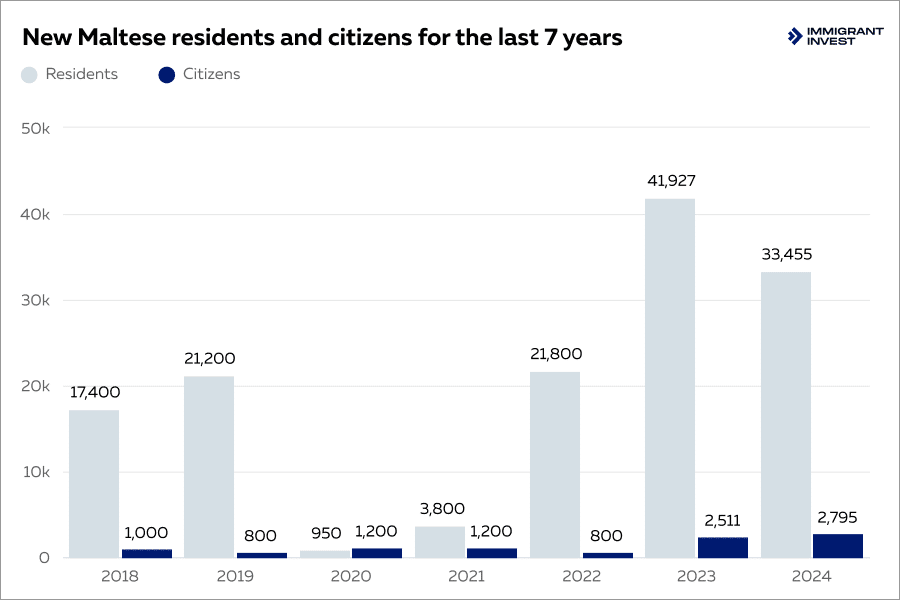
Malta does not grant citizenship in exchange for investment. Foreigners can obtain the country’s passport by naturalisation or by merit.
Foreigners can obtain a Malta passport by naturalisation after 5 years of holding permanent residence status.
To be eligible for citizenship, they must meet the following requirements:
In addition, applicants need 2 sponsors who are not relatives. The first sponsor must be a professional, such as an advocate, notary public, medical practitioner, senior public officer, police inspector, or another eligible person. The second sponsor may be any Maltese citizen over 18 who did not acquire citizenship by naturalisation[5].
The final decision is made at the discretion of the Minister responsible for citizenship matters.
The following information is provided for educational purposes regarding the legal provisions of Subsidiary Legislation 188.06. Citizenship by merit in Malta is a discretionary, independent process and is neither a continuation of, nor an alternative to, any former citizenship by investment schemes.
Malta citizenship by merit is designed for applicants who have made or can make an exceptional contribution to Malta or humanity. Contributions may relate to entrepreneurship, job creation, innovation, scientific research, education, healthcare, culture, sport, philanthropy, social impact, national security, or strategic initiatives aligned with Malta’s interests.
Citizenship by merit is not an investment programme and has no fixed investment threshold. Each application is assessed individually by the Community Malta Agency.
Applicants are generally expected to meet the following criteria:
They must also demonstrate a genuine connection with Malta, including legal residence in the country, basic knowledge of English or Maltese, and meaningful ties to Malta.
A spouse or partner, minor children, and financially dependent adult children or parents may be included in the request if they meet the eligibility and integration conditions.
Malta allows dual citizenship, so investors can keep their original passports when obtaining Maltese nationality.
The country also recognises dual and multiple citizenship acquired by birth, descent, marriage, or ordinary naturalisation. Applicants do not need to renounce their first nationality unless required by the laws of their home country.
Malta permanent residency comes with a wide range of entitlements that extend beyond the right to live in the country. Holders enjoy life-long status, favourable tax treatment, family reunification options, and access to social and cultural benefits.
Once granted, permanent residency does not expire as long as the conditions are maintained. It is only required to renew the residency card every 5 years.
Under the Malta Permanent Residency Programme, residency can be inherited under certain conditions, such as in the event of a beneficiary’s death. In these exceptional circumstances, the Agency has the discretion to transfer the residency certificate to an approved dependent, subject to specific conditions that the Agency may impose at its discretion.
The Agency evaluates each case individually, considering factors such as the dependent’s relationship to the deceased person and the financial dependency. The Residency Malta Agency has the authority to set specific conditions for transferring residency status.
The dependent must provide the Agency with evidence that all conditions have been met. Only once the Agency determines that the requirements are satisfied, will the residency certificate be issued to the approved dependent.

While Malta Permanent Residency grants the right to live in Malta, it does not automatically confer tax residency. To qualify as a tax resident, one must spend at least 183 days per year in Malta.
If a permanent resident becomes a Maltese tax resident but remains non-domiciled in Malta, they may be taxed on a remittance basis. This means that foreign-source income is taxed in Malta only if it is received in, or transferred to, the country. The tax is usually charged at Malta’s standard progressive rates, ranging from 0 to 35%[6].
By comparison, Spain taxes its residents on worldwide income at progressive rates of 19 to 47%, while Italy applies rates of 23 to 43%.
Malta also imposes no taxes on foreign assets, inheritance, wealth, capital gains, and property for both residents and citizens.
Residents can apply for family reunification to include their spouse, minor children, and other dependents under certain conditions. For the application to be successful, the resident must hold a residence permit with a validity of at least one year, have prospects of permanent residency, and comply with family reunification regulations[7].
Investors who participated in the MPRP can add the following dependents at the post-approval stage:
Permanent residents can open both personal and corporate bank accounts in Malta-based banks and EU financial institutions. There are no restrictions based on nationality once residency is granted.
EU nationals can drive in Malta with a licence from their home country, as long as it is valid there.
Non-EU citizens can drive in Malta with a foreign licence for the first 12 months. After that, they must exchange it for a Maltese licence. To do so, they need to pass both the theory and practical tests but are not required to attend a Maltese driving school. Citizens of Switzerland, Australia, the UAE, and the UK do not need to take the test[8].
Malta permanent residents have access to a range of discounts, starting with the Tallinja Card, which offers discounted bus fares across Malta and Gozo. The annual Tallinja card costs €150 for adults and €84 for students, as opposed to the regular price of €180.
Residents can also access financial support for cultural projects including those organised by the Malta Arts Council. This includes projects in music, literature, visual arts, performing arts, and cultural heritage. Importantly, foreign nationals who do not hold Malta residency are not eligible for this funding.
The easiest way to get Malta residency is to participate in the Malta Permanent Residence Programme. It requires an investment of at least €169,000 and allows you to obtain the status in 6 or more months.
Yes, it is relatively easy to obtain Malta permanent residency. The investor does not need to find a job, enrol in a university, or have family ties with a Maltese national. They are also not required to live in the country to maintain their status.
The requirements under the Malta Permanent Residence Programme are the following:
The minimum investment required to obtain Malta permanent residence is €169,000. This amount applies if the investor rents real estate and does not include any family members in the application.
Yes, you can obtain Maltese permanent residency by purchasing real estate for at least €375,000. Additionally, you must pay a contribution fee of €37,000, an administration fee of €60,000, and donate €2,000 to a charity.
You cannot obtain Maltese citizenship by investment.
However, you can get a residence status, if you participate in one of the following programmes:
To obtain Malta citizenship after permanent residence, you must live in Malta for at least five years, demonstrate good character, financial stability, and language proficiency.
Yes, as a US citizen, you can live in Malta. You would need to apply for a residence permit, such as through the Malta Permanent Residence Programme.
Malta is a great destination for US citizens, thanks to a strong community of American expats, English being one of the official languages, and the possibility to obtain Malta tax residency status.
No, you cannot directly buy residency in Malta. Investors become residents through the Malta Permanent Residence Programme. It requires an investment in property, a contribution to the national development fund, paying an administration fee, and a donation to a local charity. The minimum investment is €169,000.
The whole process of obtaining Malta permanent residence under the Malta Permanent Residence Programme takes at least 6 months. It includes document collection, Due Diligence by Maltese authorities, fulfilling the investment conditions, and submission of biometrics in person in Malta.
Yes, investors can include their spouse, children, parents, and grandparents in the Malta Permanent Residence Programme application. The minimum expenses for a family of four are €182,100.
The Malta Permanent Residence Programme does not require investors to live permanently in the country. Part of the investment might be returned in 5 years if the applicant chooses to purchase real estate.
The permanent residence status allows its holder to travel to any state of the Schengen Area visa-free, obtain tax-residence status, be employed by a Maltese company, including top management positions, and do business.
There are two ways for foreign nationals to obtain permanent residence in Malta:
Yes, you can, if you participate in the Malta Global Residence Program. It implies obtaining a residence permit after renting or purchasing an apartment.
To qualify for the Malta Global Residence Programme, the rent should cost at least €8,750, and the minimum price for a real estate purchase is €220,000. Aside from that, applicants pay an administrative fee of €5,500 or €6,000 depending on the region of the country they chose accommodation in.
The processing of the applications takes at least 3 months.
To rent or buy property in Malta, investors can work with a local real estate agent or manage the process on their own.
Immigrant Invest helps clients find trusted realtors and supports them throughout the rental or purchase process.
No, it will not be enough. For the Malta Permanent Residence Programme, only the property price stated in the sale and purchase agreement counts. So, if the property costs €190,000 and you spend €100,000 on renovation, the total will not qualify. The property itself must cost at least €375,000.
For some family members, it is required to provide a notarised certificate of principal dependency. This is the case with the investor’s children over 18 years old, as well as the parents and grandparents of the applicant and their spouse.
The key difference between permanent residency and citizenship in Malta lies in the rights and privileges granted. Permanent residency allows individuals to live in Malta indefinitely with access to health care and other social services but does not confer the right to vote and is limited in terms of EU mobility rights.
Citizenship grants full rights, including the ability to work and reside anywhere within the EU, vote in elections, and travel visa-free to over 160 countries.