Malta offers several paths for foreigners who want to make it their home. For example, they can obtain citizenship just one year after receiving a residence permit if they choose the citizenship by naturalisation for exceptional services through the direct investment route.
Another path to a passport is through marriage to a Maltese national or by residing in Malta for at least five years.
Today’s guide sheds light on the country’s residency, followed by citizenship status.




In most cases, foreigners seeking Malta citizenship must first obtain a residence permit. After a certain time, they can apply for citizenship.
Only those born after August 1st, 1989, to at least one Malta citizen automatically receive a Malta passport, regardless of the place of birth. Others can obtain citizenship by descent, marriage, family reunification, ordinary naturalisation, or naturalisation for exceptional services by direct investment.
1. By marriage. Marrying a Maltese citizen may lead to citizenship after five years. Foreigners may still obtain citizenship if separated, divorced, or widowed, as long as the marriage lasted at least five years. Same-sex marriages are recognised.
To apply, the foreign spouse must submit documents including a passport, birth certificate, marriage certificate, and proof of at least one year's residence in Malta. They must also demonstrate working knowledge of English or Maltese, pass a Due Diligence check, and pay the required fees.
2. By descent. Individuals with Maltese ancestry may claim citizenship if they can prove their lineage. This usually requires tracing back to a Maltese grandparent or, in some cases, a great-grandparent. Former Malta citizens and foreigners whose mothers were or could have become Malta citizens by birth can also apply.
Applicants must have resided in Malta for at least one year before registering for citizenship.
When filing an application, one submits documents, including birth and marriage certificates of two consecutive generations of Malta‑born ascendants. For the third and subsequent generations, a citizenship certificate of the Malta‑born ascendant is required.
3. By family reunification. Those with family members who are Maltese citizens or permanent residents may be eligible for citizenship through the family reunification scheme. This option is mainly available to children of current or former Maltese citizens born in the country or abroad under certain conditions.
Third-country nationals who have held a Malta residence permit for at least one year can bring their spouses, parents, and minor children to Malta. These family members may later become eligible for citizenship.
4. By naturalisation. Foreigners who have continuously lived in Malta can obtain citizenship by naturalisation. They must reside in Malta for 12 months immediately before the application and spend at least 4 years in the country during the last 6 years before the 12‑month period.
Other requirements include speaking English or Maltese, having good character, and providing two Maltese sponsors who can vouch for the applicant's conduct.
5. By naturalisation for exceptional services by direct investment. Foreigners can obtain Malta citizenship by meeting specific investment requirements. They first receive a residence permit, followed by a passport within 1 or 3 years.
By law, investors must apply through a licensed agent approved by the Government of Malta.
To be eligible for Malta citizenship, an investor must:
Investors can include family members in their applications: spouses or registered partners and dependent relatives, such as children under 29 and parents or grandparents over 55. All applicants over 12 must undergo a 4-tier Due Diligence check, involving a thorough review of their criminal backgrounds and character.
There is no investment-based path to Malta citizenship. Maltese nationality legislation provides for the possibility of naturalisation in cases of exceptional merit.
The statutory framework recognises exceptional contributions across various areas, such as entrepreneurship, job creation, innovation, science, education, culture, or philanthropy.
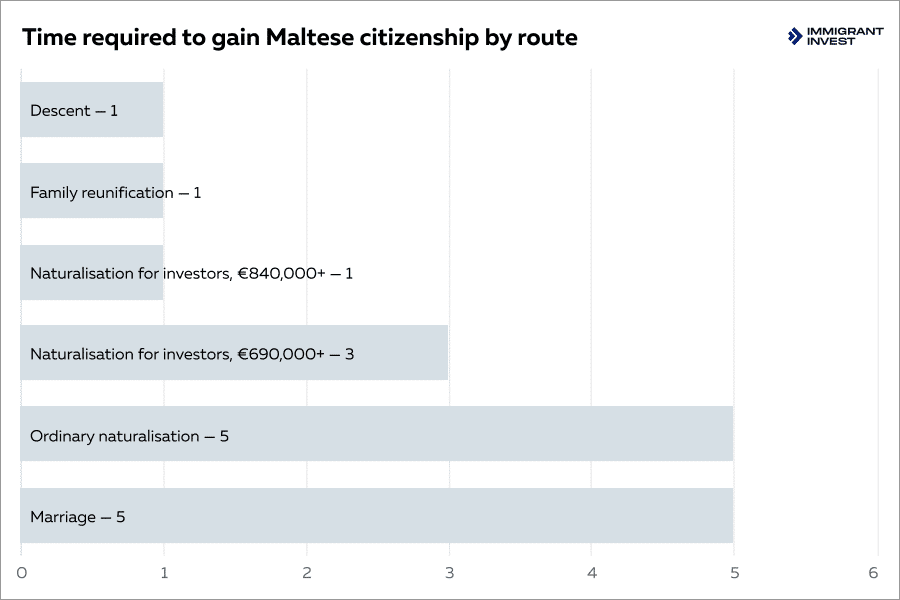
There are three mandatory requirements for investors who want to obtain Malta citizenship by naturalisation for exceptional services.
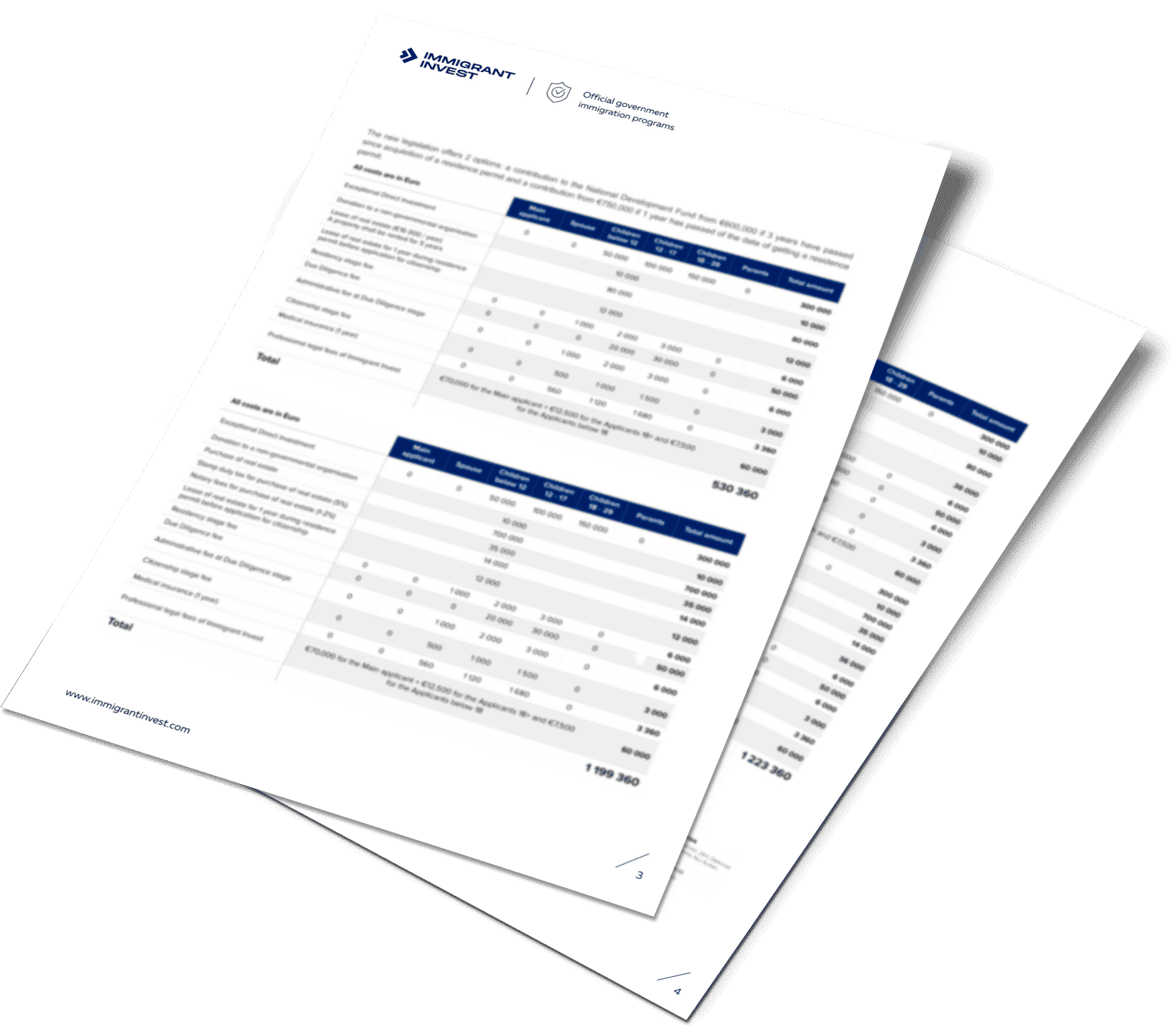
Non-refundable contribution. Investors contribute either €750,000 or €600,000 to the National Development and Social Fund, NDSF. An additional €50,000 is required per family member included.
Investors commit to a 1-year residency if their NDSF contribution is €750,000, or a 3‑year residency if their contribution is €600,000. After the residency period, they can apply for Malta citizenship.
Buying or renting a residential property. Prior to obtaining citizenship, there is no requirement for the rent price. Normally, it is approximately €12,000 during the residency period. Once an investor obtains citizenship, the minimum annual rent increases to €16,000. The investor must rent the property for at least 5 years post‑citizenship.
Buying property is another option, with the minimum price being €700,000. The investor must retain ownership for at least 5 years after acquiring a Malta passport.
Donation. Investors donate at least €10,000 to a registered charity in Malta.
Additional expenses. When applying, the investor pays additional fees depending on the number of participants included in the application:
In total, a single investor pays approximately €23,500 in additional fees. For a family of four, the cost starts at around €47,000.
According to the experience of Immigrant Invest lawyers, the whole process of obtaining Malta citizenship takes at least 1.5 years, including the residing and document consideration periods and Due Diligence checks.
The investor contacts Immigrant Invest, a licensed agent that acts on behalf of the investor and their family. We run a preliminary Due Diligence check for the participants at this stage.
This is the first tier in the four-tier Due Diligence process required by Malta.
Immigrant Invest lawyers assist in collecting the documents and filing forms. Then, we submit the documents to the Community Malta Agency. The authorities run a criminal record check on the investor and their family.
This is the second Due Diligence tier.
The investor purchases or rents real estate and then obtains a residence permit for either 1 or 3 years, depending on the pledged contribution to the NDSF.
Within 12 months after becoming Malta residents, the investor and their family undergo the third tier of Due Diligence: the Eligibility Assessment. This test reviews funds, sources of wealth, and ensures there are no international sanctions.
Then, assessors create a risk report as part of the fourth Due Diligence tier. They review all previously gathered information, ensuring correct document formats and notarisation.
As a final step, the Minister responsible for citizenship evaluates each application and decides whether to approve or reject it. If approved, the investor becomes eligible to apply for citizenship.
The investor submits a citizenship application and an affidavit confirming that their circumstances have not changed since the check. If any changes occurred, they provide updated details.
For applications submitted after 3 years, the investor must also provide an updated police clearance certificate.
The Community Malta Agency’s board reviews the applications and forwards them to the Minister for Citizenship, who issues a Letter of Approval.
Upon approval by the Minister, the investor makes a contribution to the National Development and Social Fund:
They also make a charitable donation of €10,000 and, if needed, enter into a new real estate lease agreement.
All participants visit Malta to submit biometric data, take the Oath of Allegiance, and receive their passports.
Malta residents can apply for citizenship or permanent residence by naturalisation after at least 5 years of living in the country, of which one year before application must be continuous.
Applicants must be over 18 and have sufficient income to support themselves. They also provide recommendations from two local sponsors.
When applying for Malta citizenship by residency, applicants submit:
Residence permits that applicants hold prior to citizenship can be obtained under multiple grounds: studying, employment, family reunification, and investment. However, not all residence permits lead to citizenship. For example, time spent in Malta under a digital nomad residency does not count towards citizenship eligibility.
Investors are offered two options to get residency in Malta.
Malta Global Residence Programme offers a temporary residence permit for investors. The residence permit card is renewed after the first year and every two years thereafter.
Applicants choose between:
Additionally, investors pay an administrative fee of €5,500 or €6,000 and at least €15,000 in annual income taxes.
Malta Permanent Residence Programme is also designated for investors and grants a life-long resident status. The resident card under this programme must be renewed every five years or replaced by a passport. Investors cannot automatically convert Malta permanent residence to citizenship, but they are eligible for ordinary naturalisation.
Investors must meet specific financial criteria. They must confirm a net worth of €500,000, where at least €150,000 is in liquid financial assets. Alternatively, they can have a capital of €650,000, with at least €75,000 in liquid financial assets.
For real estate investment, investors can choose between two options:
An additional contribution fee of €5,000 applies for each family member included in the application.
Investors must donate €2,000 to a charitable organisation. An administration fee of €50,000 is required, along with an additional €5,000 for each dependent included in the application.
1. Freedom of travel. Malta passport holders can travel visa‑free to over 169 countries, including the Schengen Area, the US, the UK, and Canada.
2. Dual citizenship. Malta recognises dual citizenship, so foreigners do not need to renounce their other nationalities when obtaining a Maltese one.
3. Favourable tax residency. Malta citizenship does not include special tax privileges. However, companies in Malta may benefit from various deductions, allowing them to pay income tax at rates between 0—10%, rather than the standard 35%.
4. Profitable real estate. Investors add local property to their assets due to Malta’s steady price increases. Residential real estate rises in value by 5—10% annually.
5. Education and healthcare of the European calibre. Malta offers a strong education system with public and private schools and universities. Citizens benefit from a universal healthcare system, and they can also access medical treatment and higher education across the European Union.
6. Strategic location for business and travel. Malta is one of the most important hubs for Mediterranean and global commerce. The country is well‑connected to major parts of Europe by land, sea, and air.
7. Rich culture. Malta boasts a history of settlements dating back 7,500 years, beautiful architecture, a pleasant climate, and friendly people.
Both Maltese permanent residency and citizenship offer similar rights — including life‑long status, the ability to buy real estate, work, run businesses, open bank accounts, and access medical services. However, there are key differences between the two.
Obtainment period. The process of getting Malta permanent residency lasts 6+ months, while citizenship requires at least one year of holding a residence permit.
Investment sum. The minimum investment for permanent residence is €187,000, while obtaining citizenship requires at least €690,000.
Global mobility. Permanent residents can travel visa-free only within the Schengen Area, whereas citizens have visa-free access to 169 destinations.
The main difference between Maltese permanent residence and citizenship lies in the range of rights and opportunities they provide.
As a permanent resident, you can live in Malta and access local social benefits, but you’ll need a separate permit to live or work in any other EU country.
Citizenship, however, opens far more doors, allowing you to live, work, study, or start a business anywhere in the EU without the need for additional permits. Plus, you gain the right to reside in non-EU Schengen countries like Switzerland, Norway, Iceland, and Liechtenstein, offering truly borderless living across much of Europe.

Malta allows its citizens to hold two or more passports. This means foreigners who obtain Maltese citizenship do not need to renounce their other nationalities, provided their home countries also recognise dual citizenship.
For instance, the USA recognises dual citizenship, allowing citizens to hold both US and Maltese passports. China, however, prohibits dual citizenship, so Chinese citizens might need to renounce their citizenship upon obtaining a Maltese passport.
Taxes for individuals. Maltese tax residents pay income tax on wages at rates ranging from 0 to 35%, depending on their marital status and income level.
Dividends and interests are taxed at 15%. Royalties are not taxed.
Social security contributions are 10% for employees and 15% for self‑employed individuals.
Taxes for legal entities. The corporate tax rate is 35%, but it can be reduced to 0% through tax refunds. For example, a full refund applies if a Maltese company holds at least a 10% share in a non-resident company.
The standard VAT rate is 18%. However, it may be reduced based on the services provided. For example, tourist accommodations are taxed at 7%, and food and pharmaceuticals are VAT-exempt.
Property taxes. When purchasing real estate, a person must pay 5% of its value. There is no tax on property ownership, though land ownership may incur a tax.
No tax is levied on the sale of residential property if it has been owned for more than 3 years. Otherwise, a 5% stamp duty applies. Sales of non-commercial properties are taxed at a minimum of 5%.
There is no inheritance tax in Malta. However, a stamp duty of 3.5 to 5% applies to inherited property, unless the inheritor is a child or spouse of the deceased.
Malta allows naturalisation for exceptional services by direct investment, and one of the requirements is to reside in Malta for 1 or 3 years, depending on the investment amount. These resident permits are issued after thorough Due Diligence procedures, and applicants can pursue citizenship only after the permits expire.
The entire process is multi-layered and requires the assistance of a licensed agent.
There are other ways to get Malta citizenship after residency. Citizenship can also be obtained without investment through descent, marriage, family reunification, or ordinary naturalisation.
Investors who apply for Malta naturalisation for exceptional services must hold residence permits in Malta for 1 or 3 years, depending on the investment conditions they choose. After that, they can apply for citizenship.
Foreigners registering for Malta citizenship by marriage, or ordinary naturalisation typically need to live in Malta for 5+ years. Citizenship by descent or family reunification can be granted after 1 year of residence.
Yes. There are several ways to get Malta citizenship: marriage, family reunification, descent, or exceptional services by direct investment.
No, you cannot “buy” residency in Malta. Investors who want to contribute to the Malta economy and relocate to the country can apply for Malta naturalisation for exceptional services by direct investment or participate in the Malta Global Residence Programme or Malta Permanent Residence Programme.
Yes. Foreigners who have been living for 5 years in Malta can apply for permanent residence status.
Yes, a US national can obtain Malta citizenship and keep their American passport. They have several routes:
It is relatively easy to obtain Maltese residency. Malta offers two investment programs for this purpose.
For a temporary residence permit, one must rent or buy real estate. The minimum sums are:
Investors also pay an administrative fee of €5,500+ and an annual income tax of at least €15,000.
For permanent residency, investors rent or buy real estate costing:
They also pay a state fee of €30,000—60,000, an administrative fee of €50,000, and donate €2,000 to a charitable organisation. Investors also prove they have assets of at least €500,000 available.
Investors cannot automatically convert Malta PR to citizenship, but they may acquire a Maltese passport through ordinary naturalisation after residing in the country for at least five years.
Yes, Malta permits dual citizenship, so a new citizen does not need to renounce their previous nationality when obtaining a Maltese passport. However, this applies only if the other country also recognises dual citizenship.
Malta does not grant citizenship by investment in real estate.
However, one can get citizenship by naturalisation for exceptional services by direct investment. This process involves renting or buying property, acquiring a residence permit, and then applying for citizenship after 1 or 3 years, depending on your investment. This pathway provides a faster route to citizenship compared to ordinary naturalisation.
The minimum time a foreigner needs to wait is 1 year. To be eligible to apply for citizenship after this period, they need to fulfil several requirements:
Once these requirements are fulfilled, the investor can apply for citizenship by naturalisation.
The citizenship of every European country, Malta included, can be considered European.
Yes, you can obtain residency in Malta by purchasing property. For a temporary residence permit, the minimum property value is €220,000. For permanent residency, the property must be worth at least €375,000.
Other requirements include:
The minimum sum of investment is €30,000 for a temporary residence permit and €187,000 for permanent residency.
Malta does not offer citizenship by investment. However, individuals can apply for citizenship by naturalisation for exceptional services by direct investment. This involves making investments, obtaining a residence permit, and then applying for citizenship after 1 or 3 years.
In terms of rights and privileges, Maltese citizenship provides full benefits, including the right to vote, obtain a Maltese passport, and enjoy unrestricted movement within the EU. Permanent residency, on the other hand, allows for indefinite stay in Malta with access to healthcare and social services, but does not include voting rights and offers only limited mobility within the EU.
Regarding travel and mobility, Maltese citizens can enjoy visa-free access to over 165 countries, including the Schengen Area, the UK, the US, and Canada. Permanent residents are limited to visa-free travel within the Schengen Zone for up to 90 days within any 180-day period.