







There are several ways to obtain Maltese citizenship: for instance, by birth, by descent, or after marriage to a citizen of the country. For those who don’t have family ties with Maltese nationals, there is naturalisation.
The naturalisation path requires applicants to reside in the country legally for at least 5 years. A specific form of naturalisation is Malta citizenship by merit. It requires demonstrating a significant contribution or service that aligns with Malta’s national interest while holding legal residence in the country.
In this guide, we’ll look at each way to obtain Malta nationality in detail.
Grounds for obtaining citizenship in Malta
The Maltese Citizenship Act categorises all the ways to obtain citizenship in the country[1]Source: Malta Legislation — Maltese Citizenship Act.
By birth or descent. People born in a family where at least one parent is a citizen of Malta get citizenship of the country regardless of whether they were born on its territory or outside of it.
By registration. Citizenship by registration applies to relatives of Maltese nationals — their spouses, widows or widowers, and direct descendants.
By marriage. Foreign nationals married to Maltese citizens can apply for citizenship after being married for five years and living together in Malta for the preceding six months. This path falls under the registration category.
By naturalisation. Foreigners legally residing in Malta for at least five years can apply for Maltese citizenship by naturalisation.
By merit. Naturalisation is also available to foreign entrepreneurs, innovators, and philanthropists whose contributions align with Malta’s national interest. Each request for naturalisation by merit is assessed on a case-by-case basis by the Community Malta Agency, and the outcome is not guaranteed.
For refugees and political asylum. Refugees can obtain citizenship status under the general rules of naturalisation after at least five years of residency.
Obtaining Malta nationality by merit
Malta citizenship by merit is available to foreigners who can show an exceptional achievement that aligns with Malta’s national interest. There is no checklist or guaranteed criteria for this legislative framework. Each application is assessed individually.
Areas where contribution may be relevant
Candidates for citizenship by merit are foreigners over 18 years old who can demonstrate exceptional contribution or clear potential in areas important to Malta’s development, including:
- scientific research;
- healthcare and life sciences;
- education and academic excellence;
- culture, arts, creative industries, and cultural diplomacy;
- sports and top-level athletic achievement;
- entrepreneurship, strategic business leadership, and job creation;
- tech innovation and digital transformation;
- philanthropy, humanitarian work, social cohesion, and inclusion;
- national security, or projects aligned with Malta’s long-term strategic goals, including Malta Vision 2050 [2]Source: Government of Malta — Malta’s Sustainable Development Strategy for 2050.
Key considerations
Even though there’s no set criteria for Malta citizenship by merit, there are some integration details without which an applicant will not be considered.
1. Continuous residence. Candidates for Malta citizenship by merit may become eligible after residing in the country for at least 8—12 uninterrupted months. Applicants may be required to show their utility bills, tax registration, and official address registration.
2. Project proposal. Applicants submit a Proposal letter that explains a tangible benefit to Malta. The letter should include:
- introduction of the applicant and their family members;
- information on the applicant’s key achievements and evidence, such as awards, citations, patents, or media coverage.
- detailed description of the service or contribution that the applicant already has or is planning to perform;
- post-citizenship engagement plan, setting out ongoing involvement and expected presence in Malta.
3. Language. Applicants for Maltese nationality must demonstrate adequate knowledge of Maltese or English, supported by IELTS, TOEFL, GCSE, or an equivalent certificate.
Explanatory guide
Find out everything you need to know about Malta citizenship by merit
How to submit a request for Malta nationality by merit: application process
Since every application for Malta citizenship by merit is reviewed individually, there’s no set timeline for this process.
Below are the general steps applicants take within the application process.
Preliminary Due Diligence
Immigrant Invest checks eligibility for Malta citizenship application. Preliminary Due Diligence is an in-house procedure that is intended to flag potential denial risks. The check is confidential, and only a passport is needed.
Immigrant Invest checks eligibility for Malta citizenship application. Preliminary Due Diligence is an in-house procedure that is intended to flag potential denial risks. The check is confidential, and only a passport is needed.
Obtaining residence
Before they apply for citizenship, applicants obtain residence in Malta. For this step, they are required to have health insurance and residential property in the country.
Before they apply for citizenship, applicants obtain residence in Malta. For this step, they are required to have health insurance and residential property in the country.
Preparation of the proposal letter
Immigrant Invest lawyers prepare the documents that demonstrate the applicant’s background, ties to Malta, and their contribution to the state.
Immigrant Invest lawyers prepare the documents that demonstrate the applicant’s background, ties to Malta, and their contribution to the state.
Eligibility assessment
The papers, including the Proposal Letter, are submitted for Due Diligence. The Evaluation Board assesses the proposal and contribution to decide whether the applicant is eligible for Malta citizenship.
The papers, including the Proposal Letter, are submitted for Due Diligence. The Evaluation Board assesses the proposal and contribution to decide whether the applicant is eligible for Malta citizenship.
Approval in Principle
Successful applicants receive Approval in Principle, after which they can proceed with their planned contribution.
Successful applicants receive Approval in Principle, after which they can proceed with their planned contribution.
Conclusion of the discretionary process
The Evaluation Board performs the final review and Community Malta Agency conducts the final check to ensure that the applicant fulfilled the planned service or contribution.
If the final assessment is positive, the candidate can proceed to the citizenship application.
The Evaluation Board performs the final review and Community Malta Agency conducts the final check to ensure that the applicant fulfilled the planned service or contribution.
If the final assessment is positive, the candidate can proceed to the citizenship application.
Obtaining Malta citizenship by naturalisation
Naturalisation is a route to citizenship for foreign nationals who do not have Maltese relatives and cannot prove descent from Maltese nationals. In broad terms, it requires continuous residence in Malta and strong ties to the country.
Eligibility
Before applying for Malta citizenship by residency, applicants must reside in the country for at least five years within the last seven years preceding the application [3]Source: Malta Community Agency — Acquisition of citizenship by naturalisation.
Naturalisation represents the longest path to Maltese citizenship. Officially, the applicants are required to be a country’s resident for only five years, but in practice, for those who don’t have Maltese origin, it could take up to 18 years of residing in Malta to be granted a passport.
Malta nationality requirements
Five years of physical residency in the country should include 12 months of continuous presence there before the application and four cumulative years in the six years preceding those 12 months.
Additionally, the applicant must meet the following conditions:
- prove adequate knowledge of Maltese or English language;
- have a permanent place of residence, either rented or owned;
- be a person of good character and a suitable citizen of Malta;
- find two sponsors to complete the application.
The sponsors guarantee that the applicant is a person of good character and is suitable for Malta citizenship. It’s required that the sponsors and the applicant have known each other for two or more years and are not relatives.
One of the sponsors has to be a representative of one of the following professions:
- a member of Parliament;
- a judge;
- a magistrate;
- an advocate;
- a notary public;
- a legal procurator;
- a medical practitioner;
- a public officer;
- a police officer;
- an officer of the Armed Forces of Malta;
- a parish priest.
The second sponsor can be any Maltese citizen over 18 years old who did not acquire their passport by naturalisation.
Expenses
The application fee is €450. If the application is accepted, the candidate is also required to pay €50 for the issuance of the citizenship certificate.
Aside from the fees, applicants pay for translation and notarisation of documents that are not written in Maltese or English. In some cases, apostilling documents might be required.
Acquiring Malta citizenship by birth or descent
People with Maltese roots obtain citizenship either by birth or by descent.
By birth
Getting citizenship by birth is free of charge. A baby born in Malta to a family with at least one parent who acquired Maltese citizenship by birth, naturalisation, or registration becomes a citizen of Malta. These rules also apply to individuals born outside Malta after July 31st, 1989. Citizenship by birth is granted automatically.
If a person was born before July 31st, 1989, citizenship was granted only if their father was a Maltese citizen at the time of birth, or they were born in Malta and their father, who did not have Maltese citizenship, did not have diplomatic immunity.
By descent
A descendant in the direct line of an ascendant born in Malta, with a parent also born in Malta, can apply for citizenship by registration on the grounds of descent.
This case falls under the category of citizenship by registration. Descendants of Maltese citizens can apply for citizenship from outside Malta — they can submit their application to any of the Maltese Representations Overseas [4]Source: Malta Government — Consular Plus.
For descendants, the citizenship acquisition process can take from five months to two years.
The application fee for citizenship by registration is €150. If the application is accepted, the candidate has to pay an additional €50 for the certificate issuance.
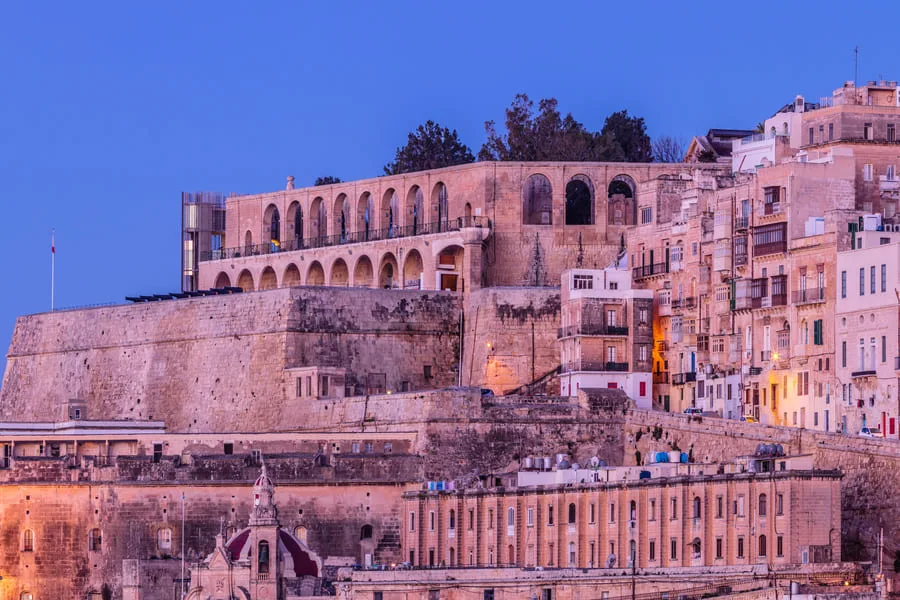
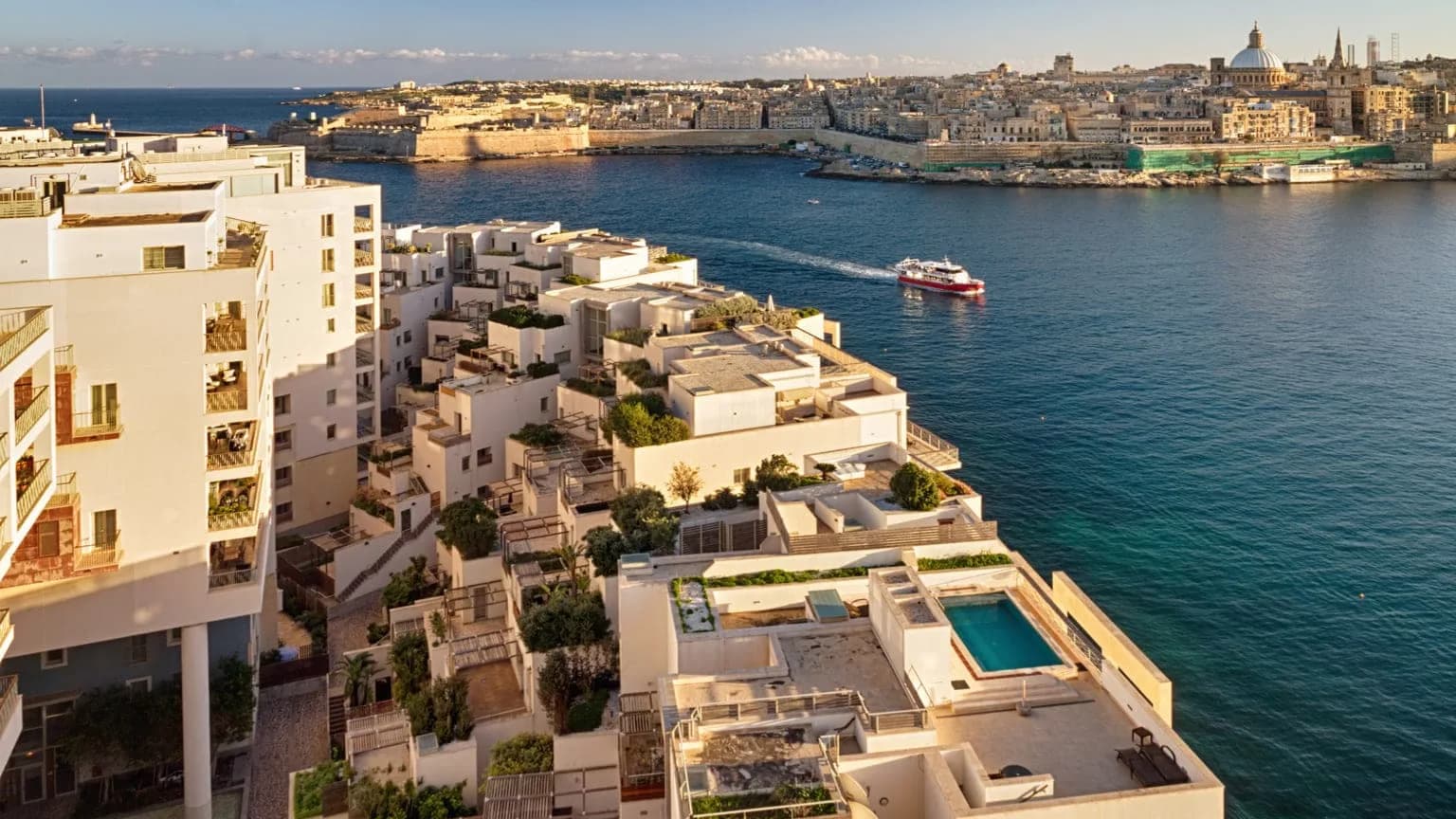
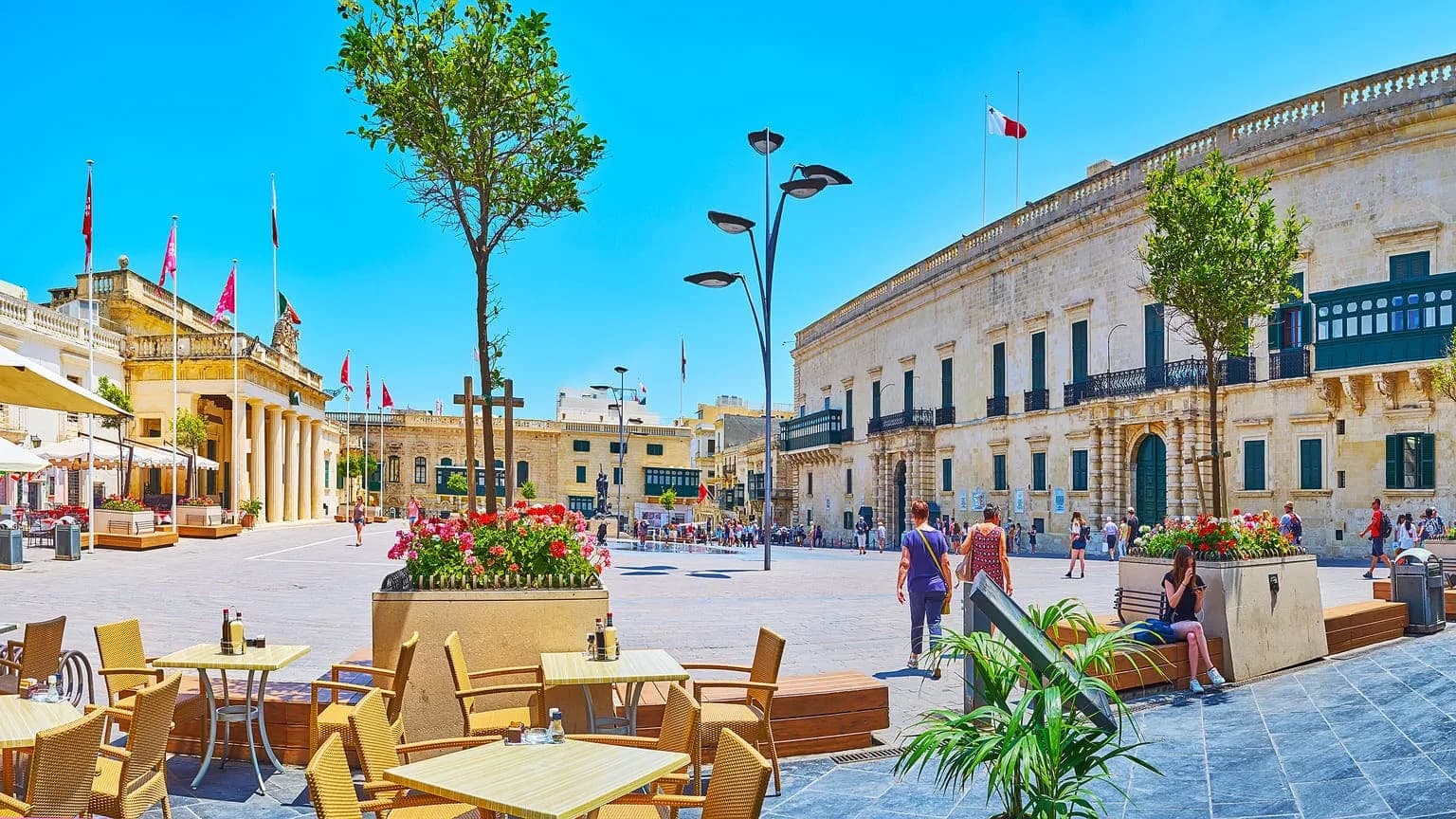
Valletta, the capital of Malta, is a vibrant city where historic culture meets the open sea and lively streets
Getting a passport of Malta by marriage
When a spouse of a Maltese national applies for citizenship after marriage, their application is categorised as citizenship by registration.
Malta nationality requirements
Spouses can obtain a passport of Malta if they have been married to a Maltese citizen for at least five years. The same applies to registered partners who have been in a relationship with a Maltese citizen for five years. The primary condition for the couple is that they live in one home, which does not have to be in Malta.
If the couple resides in Malta, the partner without Maltese citizenship must obtain residency for a period of five years after the marriage has elapsed.
Widows and widowers are also eligible for citizenship if their marriage to a Maltese citizen lasted more than five years.
The application fee for citizenship by registration is €150. If the application is accepted, the candidate has to pay an additional €50 for the certificate issuance.
Obtaining a Malta passport as a refugee
Malta protects refugees from third countries who have proven their lives were threatened or they have been discriminated against in their country of origin.
Refugees in Malta obtain a residency permit and a Convention Travel Document and access to employment, social welfare, education, medical care, and integration programs.
Refugees can obtain citizenship status under the general rules of naturalisation, meaning they will be granted their passports after at least five years of residency.
Dual citizenship in Malta
Malta allows dual citizenship, which means foreigners can maintain their existing nationality while acquiring Maltese citizenship. This policy is applicable whether one gains Maltese citizenship by naturalisation, by merit, or by descent.
However, it's important to check the laws of your home country, as some countries do not allow dual citizenship and may require you to renounce your original nationality.
Children born to Maltese citizens, including those who acquired their citizenship by naturalisation, generally inherit Maltese citizenship automatically. This makes it possible for dual citizenship to be passed onto future generations.
Alternative ways to move to Malta
For foreigners whose goal is to move to Malta long-term without necessarily obtaining citizenship, the country offers investment-based paths to different types of residence permits.
Malta Permanent Residence Programme
The Malta Permanent Residence Programme offers foreigners an opportunity to secure a permanent residence permit in Malta by investment.
To apply, applicants are required to fulfil all three investment conditions:
- Buy or rent real estate. Investors either purchase a residential property worth at least €375,000 or rent one with a minimum annual rent of €14,000.
- Pay state fees. The contribution fee is €37,000, and the administrative fee is €60,000 for the investor and their spouse. If there are more adults included in the application, the administrative fee increases by €7,500 per person.
- Make a charitable donation to a local NGO of at least €2,000.
Besides the investment, applicants must prove available capital of at least €500,000 with at least €150,000 in liquid assets. Another option is to show a capital of €650,000 with only €75,000 in liquid assets.
Trusted by 10,000+ investors
Check your eligibility for Malta permanent residence
Malta Global Residence Programme
Malta Global Residence Programme allows foreign investors to obtain a temporary residence permit in Malta. The permit can be renewed for as long as the investment conditions are met.
To participate in the programme, applicants rent or buy property and pay administrative fees and taxes.
Renting real estate. The minimum price of the rental property depends on its location:
- €8,750 per year for properties in the south of Malta or the island of Gozo;
- €9,600 for properties in the north and centre of Malta.
If an investor chooses to rent real estate, they pay an administrative fee of €6,000.
Purchase of real estate. The required minimum price of the property depends on its location:
- €220,000 for properties located in the south of Malta and the island of Gozo; the administrative fee in this case is €5,500;
- €275,000 for properties in any other part of the country; the administrative fee is €6,000.
Investors are not obliged to move to Malta permanently. However, they are required to become tax residents in Malta, which means they cannot spend over 183 days a year in another country.
Global Residence Permit holders pay tax at a special rate. The flat tax rate of 15% is charged on income earned abroad and transferred to Malta. The minimum tax due for a family is €15,000 a year.
Trusted by 10,000+ investors
Check your eligibility for the Malta Global Residence Programme
Living in Malta: 5 key things to know
1. Maltese culture is a mix of influences from various civilisations that have occupied the island. There are numerous cultural events, festivals, and historical sites. The Maltese are known for their hospitality and community-oriented lifestyle.
2. English and Maltese are the official languages. English is widely spoken, which makes communication easy for expatriates. Italian is also commonly understood and spoken by a significant portion of the population.
3. Malta is an extremely expat-friendly country, with almost one-third made up of people born abroad who now live in the country as residents or citizens. This is the third-highest share of foreign-born people in the European Union [5]Source: Eurostat — EU population diversity by citizenship and country of birth.
4. Malta enjoys a Mediterranean climate with hot, dry summers and mild, wet winters. This makes it an attractive destination for those who prefer year-round mild weather.
5. Getting around Malta is easy, even without a car. The island has a comprehensive public bus system, and because of its small size, travel distances are short. Owning a car is common, but traffic congestion can be an issue, especially in and around urban areas.
Why it’s a good idea to apply for Malta citizenship with Immigrant Invest
Immigrant Invest is a consulting company with a strong presence in Malta, deep knowledge of local law, and full authority to assist clients with residency and citizenship applications based on merit.
Our legal team has comprehensive experience in all local immigration procedures and operates strictly within the legal framework, including the Maltese Citizenship Act Cap. 188, Article 10 (9) [6]Source: Malta Legislation — Maltese Citizenship Act, Cap 188, Article 10.
We hold official licences issued by government authorities in several jurisdictions, including EU member states and Caribbean countries. These licences are required to represent clients in citizenship and residency by investment programmes and place the company under strict compliance obligations and direct accountability for every application it submits.
The company also has an in-house Legal and AML Compliance Department staffed by certified Anti-Money Laundering Specialists and members of the Investment Migration Council. Before any application is filed, the team carries out a thorough preliminary review to identify and resolve potential red flags. This helps reduce the risk of rejection and protects both the client’s investment and the company’s licensed status.

Albert Ioffe,
Legal and Compliance Officer, certified CAMS specialist
Before signing a contract with a potential client, we perform a Preliminary Due Diligence. It’s an in-house background check that helps us understand if the chosen residence or citizenship route is the right one for the client.
If there’s a high risk of rejection, we suggest a different, more realistic solution. This way, we help our clients achieve their goals while keeping an overall rejection rate at our company as low as 1%.
Summary on Malta nationality requirements
- The Maltese Citizenship Act defines several ways to obtain citizenship: by birth, by registration, and by naturalisation.
- Naturalisation in Malta requires at least 5 years of legal residence in the country, creating strong ties in the country and proving adequate knowledge of Maltese or English.
- Malta citizenship by merit is a naturalisation procedure for foreigners who provide a significant contribution or service that aligns with the state’s national interests. Application assessment is discretionary.
- Citizenship by registration is available to relatives of Maltese nationals, including spouses, widows or widowers, and direct descendants.
- Citizenship by descent and citizenship by marriage fall under the category of registration.
 Trusted by 10,000+ investors