






A Maltese passport can offer many advantages to its holders, such as a high quality of life, favourable business conditions, and the opportunity to travel visa-free to more than 180 countries.
Naturalisation is one of the ways to obtain a passport. In this article, we gathered detailed information on the conditions and terms of obtaining Malta citizenship by naturalisation.
What is naturalisation?
Naturalisation is a procedure that allows foreigners to obtain citizenship if they fulfil several conditions.
After the Maltese reforms introduced in 2000, those who obtain citizenship by naturalisation are no longer required to prove they’ve lost or renounced their other citizenship. Maltese authorities also allowed their citizens to have dual citizenship.
The legal basis for obtaining Malta citizenship by naturalisation are:
- Chapter III of the Constitution of Malta [1]Source: Provisions on Citizenship in Chapter III of the Constitution of Malta;
- Chapter 188 of the Maltese Citizenship Act [2]Source: Provisions Chapter 188 of the Maltese Citizenship Act;
- Subsidiary Legislation 188.06 of 2020 [3]Source: Maltese Subsidiary Legislation 188.06.
Conditions for obtaining Malta citizenship by naturalisation
According to the Maltese legislation, a foreigner can apply for citizenship by naturalisation if they fit several requirements:
- age of 18 years or older;
- have lived in Malta for 12 months continuously before applying;
- have lived in Malta for 4 years out of 6 last years before the 12 months;
- are a law-abiding member of society with no criminal prosecutions or convictions – and will remain so as a citizen of Malta;
- have own or rented housing in Malta;
- have adequate knowledge of English or Maltese; this requirement doesn’t apply to persons who are out of age but are not fully capable and on behalf of whom the application is being made.
A parent or parents who were not Maltese citizens at the time of their child’s birth and then acquired passports can apply for Malta citizenship on behalf of their minor children. And if a person is already naturalised, their newborns get Malta citizenship by birth.
Citizenship by merit. In special cases, individuals may get Maltese citizenship by naturalisation for exceptional merit. Applicants can submit a request for assessment to Community Malta Agency if they show exceptional achievements or valuable contributions to the country, as well as a connection to Malta. Each application is assessed individually, and citizenship is not guaranteed.
Explanatory guide
Find out everything you need to know about Malta citizenship by merit
The procedure of obtaining citizenship by naturalisation in Malta
Candidates who seek to obtain Maltese citizenship need to provide the following documents:
- application completed on form E;
- birth certificate;
- marriage certificate, if applicable;
- passport indicating the place of residence;
- police clearance certificate;
- 3 photos 35 x 45 mm;
- letter signed by the applicant that states the reasons for applying for citizenship by naturalisation.
It is required to provide both originals and copies of the documents. Originals must be translated if they are in a language other than English or Maltese.
Besides the candidate themselves, the application must be signed by two sponsors. One of them must be an adult citizen of Malta who didn’t acquire their passport by naturalisation. The other must belong to one of the following professions:
- member of Parliament;
- judge;
- magistrate;
- advocate;
- notary public;
- legal procurator;
- medical practitioner;
- public officer not lower than the rank of principal;
- police officer not lower than the rank of the inspector;
- officer of the Armed Forces of Malta not below the rank of captain;
- parish priest.
A fee of €450 is charged for paperwork. Another €50 must be paid upon receiving a certificate of citizenship.
Application procedure for Malta citizenship by naturalisation
Citizenship by naturalisation is granted to foreigners if they have legally lived in Malta for at least 5 years. Before obtaining their passport they need to undergo several steps.
Collection of documents
The completed list depends on the situation of an individual. Basic papers usually include an application form, a birth certificate, a marriage certificate, and a receipt proving payment of application fees. The full package of documents is sent to Community Malta Agency.
The completed list depends on the situation of an individual. Basic papers usually include an application form, a birth certificate, a marriage certificate, and a receipt proving payment of application fees. The full package of documents is sent to Community Malta Agency.
Checks by the officials
This process usually takes 9 months. The applicant must also undergo an interview with the authorities in the Police Department for Migration.
This process usually takes 9 months. The applicant must also undergo an interview with the authorities in the Police Department for Migration.
Oath of allegiance
When the application is confirmed the candidate takes several oaths including the Oath of Allegiance to the Republic of Malta.
When the application is confirmed the candidate takes several oaths including the Oath of Allegiance to the Republic of Malta.
Issuance of a naturalisation certificate and a passport
The applicant must call the Agency to collect their documents.
Anonymity is not provided for recipients of Maltese passports. Once the applicant becomes a citizen of Malta, this information is published in the Government newspaper.
The applicant must call the Agency to collect their documents.
Anonymity is not provided for recipients of Maltese passports. Once the applicant becomes a citizen of Malta, this information is published in the Government newspaper.
Benefits of Malta citizenship by naturalisation
Malta citizenship offers a combination of long-term security, mobility, and practical advantages for everyday life. Citizens can live, work, study, run a business, and access services in Malta without immigration restrictions, while also benefiting from extensive visa-free travel, favourable tax rules, and a high standard of living.
Opportunity to live in Malta
A person with Malta citizenship can visit the country anytime, even if the borders are closed for foreigners, and live there without time limits. They can buy or rent real estate, open bank accounts, run a business, study, and get medical treatment in Malta.
Running a business in Europe
Maltese citizens can live, work, and run a business in Malta without needing a work visa or employment permit. This makes it easier to start a company, manage local operations, and build a long-term professional presence in the country.
Education in Europe
Children of Maltese citizens can study in Malta without a student visa. They may also benefit from more favourable tuition conditions than international students, depending on the institution and programme.
Travelling to 180 countries visa-free
Among the countries that Maltese citizens can enter without visas are the Schengen countries, the USA, the UK, South Korea and many more.
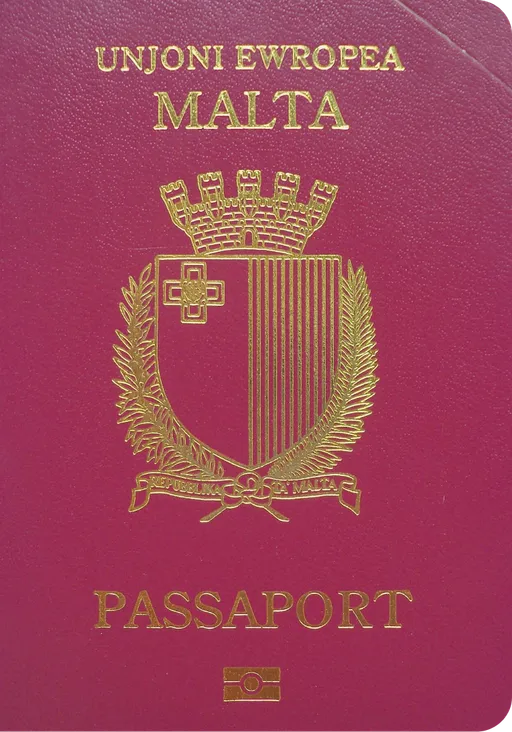
Visa Requirements for the Malta Passport
12th
place Travel Freedom Index
12th place Travel Freedom Index
| Country | Visa requirement |
|---|---|
 AfghanistaneTA | eTA |
 AlbaniaVisa-free | Visa-free |
 AlgeriaVisa is required | Visa is required |
 AndorraVisa-free | Visa-free |
 AngolaVisa-free for 30 days | Visa-free for 30 days |
 Antigua & BarbudaVisa-free | Visa-free |
 ArgentinaVisa-free | Visa-free |
 ArmeniaVisa-free | Visa-free |
 AustraliaeTA | eTA |












































































Opportunity to become Malta's taxpayer
A person with a Maltese passport can become a Maltese tax resident. This country has no taxes on inheritance, gifts, wealth or real estate ownership. Moreover, Malta has double taxation treaties with more than 80 countries, which helps to avoid double taxation [4]Source: List of Malta Double Taxation Treaties provided by the Finance Malta initiative.
High quality of life
Malta offers a Mediterranean climate with a laid-back lifestyle and scenic nature. In 2025, 13 beaches in Malta and Gozo received the internationally recognised Blue Flag certification [5]Source: Blue Flag sites.
Quality of life is also reflected in people’s everyday social experience. Malta recorded the joint-highest satisfaction with personal relationships in the EU at 8.6 out of 10, compared with an EU average of 7.8 out of 10 [6]Source: How are personal relationships rated in the EU by Eurostat.
Malta also performs strongly on physical safety. In 2024, it recorded 21 road fatalities per million inhabitants, the second-lowest rate in the EU after Sweden and less than half the EU average of 44 [7]Source: EU road fatalities decrease by 2.2% in 2024 by Eurostat.
Is dual citizenship allowed in Malta?
Since 2000, Malta has allowed its citizens to have dual citizenship. It means that a person who acquires a Maltese passport doesn't need to renounce their other citizenship. This right is noted in the Constitution of Mata in Article 22.
However, there are countries that don’t allow dual citizenship, such as China, India, and Iran. It means that if you come from such a country, you would need to renounce your first citizenship upon obtaining a Maltese passport.
Other ways to get Malta citizenship
Besides citizenship by naturalisation, Maltese law provides several other routes to citizenship, including birth or descent, marriage, family reunification, citizenship by merit, and citizenship for refugees.
Citizenship by birth or descent
Maltese citizenship may be available to children of Maltese citizens and to direct descendants of Maltese nationals.
The exact eligibility requirements depend on the applicant's date and place of birth and on how their parent or ancestor obtained Maltese citizenship. Applications by descent can also be submitted from abroad through a Maltese representation.
Citizenship by marriage
Spouses of Maltese citizens are eligible to apply for citizenship by marriage — which is called by registration. The main requirement is a duration of marriage — it must be at least 5 years. This route is also available to widows and widowers and to same-sex married couples.
Citizenship by family reunification
Close relatives of Maltese citizens qualify for citizenship by naturalisation. They obtain a residence permit for family reunification, but they have no separate route to citizenship. As a result, they must first live in the country for 5 years to become eligible for citizenship.
It applies to people with Maltese parents, siblings, or grandparents permanently living in Malta, as well as foreign children adopted by Maltese nationals and foreign guardians of minor Maltese citizens.
Citizenship by merit
Malta citizenship by merit is a discretionary form of naturalisation intended for individuals whose exceptional achievements, talents, or proposed contributions support Malta's national interests. Relevant areas may include entrepreneurship, innovation, science, education, healthcare, culture, sport, philanthropy, social impact, and strategic national initiatives.
Applications are assessed individually by Community Malta Agency. Applicants are expected to show recognised professional achievements, a genuine connection to Malta, and a contribution that goes beyond ordinary professional activity and creates clear value for the country.
Citizenship for refugees
Foreign nationals who receive refugee status in Malta may become eligible for citizenship after living in the country for 6 years. Refugees are not required to take language or public integration exams and do not pay a state fee when applying.
Key thoughts on Malta citizenship by naturalisation
- To obtain Malta citizenship by naturalisation, applicants need to reside in the country for at least 5 years, including 12 continuous months immediately before applying.
- To be eligible for naturalisation, applicants must demonstrate good conduct, permanent Maltese address, and knowledge of English or Maltese.
- Naturalisation is not anonymous. Once citizenship is granted, the new citizen’s details are published in the Government newspaper.
- Maltese citizens can live, work, study, and run a business in Malta without immigration restrictions and gain access to extensive visa-free travel. They are allowed to have dual citizenship.
- Individuals who have contributed significantly to Malta’s development may submit a request for assessment for Malta citizenship by merit.
Immigrant Invest is a licensed agent for citizenship and residence by investment programs in the EU, the Caribbean, Asia, and the Middle East. Take advantage of our global 15-year expertise — schedule a meeting with our investment programs experts.
 Trusted by 10,000+ investors