






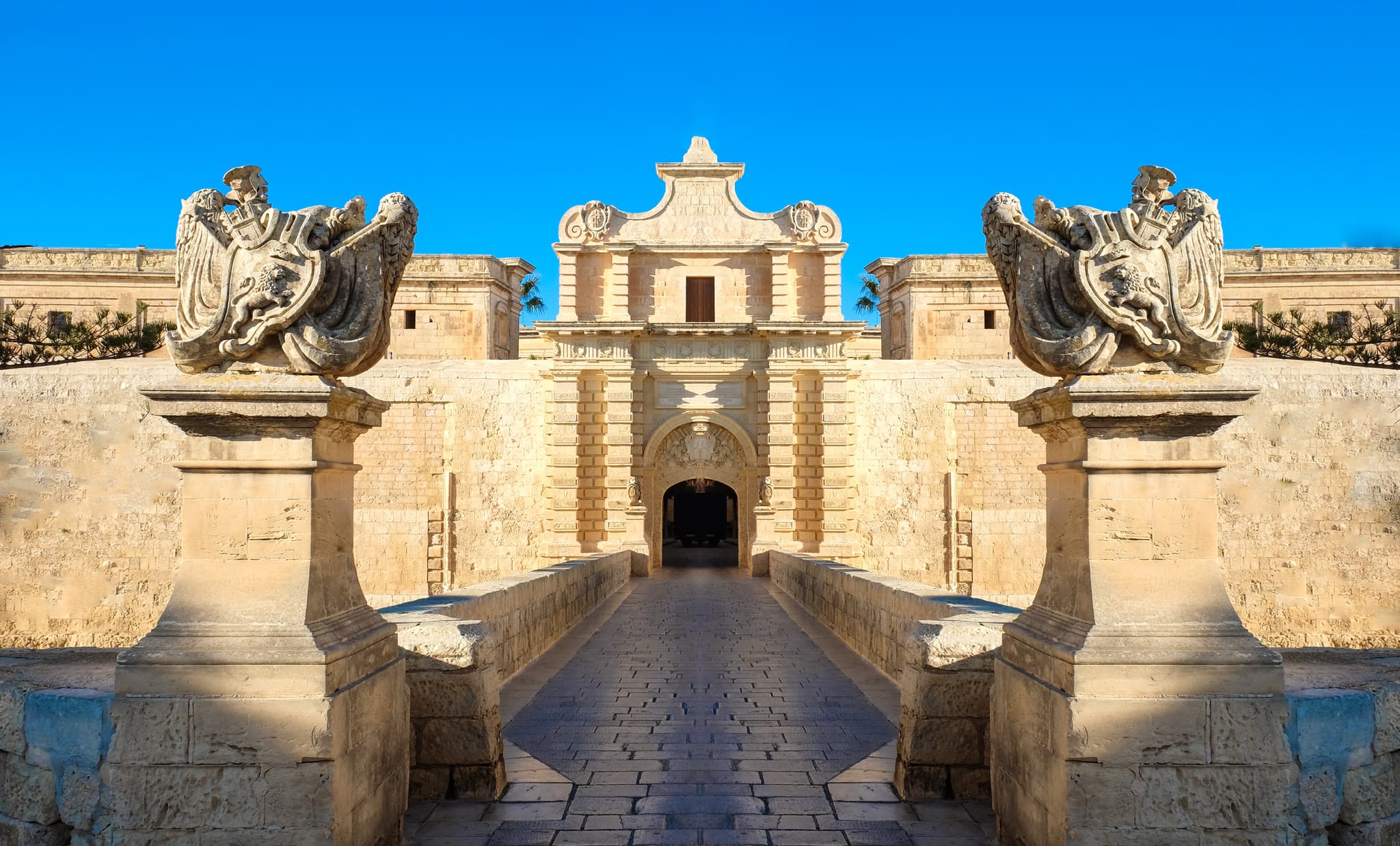

There are multiple paths to getting citizenship in Malta. Foreign nationals can obtain a Maltese passport by naturalisation, registration, birth or descent, and refugee status. The President of Malta can also grant citizenship for distinguished service to the country.
In this article, learn more about 5 ways to become a Maltese citizen.
5 ways to become a Maltese citizen
One can become a citizen of Malta on the following grounds:
- naturalisation — this path is for foreigners who have been residing in Malta for over five years;
- birth or descent;
- registration, which includes marriage;
- naturalisation by merit;
- getting citizenship as a refugee.
Let’s go through all the paths to Malta citizenship step-by-step.
Malta citizenship by naturalisation
A resident of Malta can be naturalised if they meet several requirements:
- are over 18;
- have been residing in Malta for 12 continuous months preceding the application;
- have been residing in Malta for 4 cumulative years within 6 years before the 12 months mentioned above;
- are a person of good character, which two sponsors of Maltese citizenship confirm;
- can prove adequate knowledge of the Maltese or English language.
Naturalisation is also available to former citizens of Malta [1]Source: Acquisition of citizenship by Malta Community Agency, foreign nationals with parents of Maltese citizenship, foreign nationals born in Malta from a parent of Maltese citizenship, and children of Maltese nationals who obtained citizenship on any ground.

Malta citizenship by birth or descent
There are two main categories of applicants qualifying for citizenship by birth or descent:
- Child whose parent is a citizen of Malta by birth, naturalisation, or registration.
- Descendant of a Maltese national in a direct line. If the applicant is under 18, their guardian should accompany the application process.
A Maltese passport by descent can be obtained remotely. Descendants of Maltese nationals can submit their documents to any of the Maltese Representations Overseas [3]Source: List of Malta Representations Overseas.
Conditions of obtaining citizenship by birth or descent
Malta citizenship by marriage
The case of obtaining Maltese citizenship by marriage falls under the category of acquisition of citizenship by registration.
This path to a Malta passport applies to the following:
- spouses of Maltese citizens by birth, naturalisation, or registration;
- widows and widowers of Maltese nationals;
- same-sex married couples.
In all cases, the marriage must have lasted at least five years and be still in force at the time of application.
If the applicant is a widower or widow of a Maltese citizen, they will be granted citizenship only if the marriage lasted for at least five years or would have lasted for this period by the time of the application if their Maltese national spouse had not died.
How to get Malta citizenship by family reunification
There is no way to obtain Malta citizenship by family reunification. However, close relatives may get a residence permit.
This applies to people with Maltese parents, siblings, or grandparents permanently living in the country. Foreign children adopted by Maltese nationals and foreign guardians of minor Maltese citizens are also entitled to Malta residency by family reunification.
After 5 years of living in the country, they become eligible to apply for citizenship by naturalisation.
Malta citizenship by merit
Malta citizenship by merit is a discretionary form of naturalisation based on the provisions of Subsidiary Legislation 188.06. It is available to individuals whose exceptional achievements, talents, or proposed contributions support Malta’s national interests. Relevant fields may include entrepreneurship, innovation, science, education, healthcare, culture, sport, philanthropy, social impact, and strategic national initiatives.
Applications are assessed individually by Community Malta Agency under the applicable legal framework. Applicants are generally expected to demonstrate recognised professional achievements, a genuine connection to Malta, and a contribution that goes beyond ordinary professional activity and creates clear value for the country.
A request usually includes details of the applicant’s residence and engagement with Malta, as well as a proposal describing the contribution already made or planned. This route is not a guaranteed or standard pathway to citizenship, as each case is considered on its own merits and approval remains entirely discretionary.
Explanatory guide
Find out everything you need to know about Malta citizenship by merit
Maltese citizenship for refugees
Foreigners can request political asylum and refugee status in Malta. To get the status, they need to prove that their life is threatened or they are discriminated against in their own country.
If a refugee stays in the country for six years, they become entitled to get a passport. Refugees do not take language or public integration exams and do not pay a state fee.
6 benefits of Malta citizenship
A Maltese passport allows its holder to live, work and study in the country, travel widely without obtaining visas in advance, and benefit from Malta’s healthcare and education systems.
1. An option to live in Malta
Citizens of Malta can enter the country at any desired time even if the borders are closed. Passport holders may also stay there for as long as they wish.
2. Visa-free travel to 180 countries
Maltese nationals can travel visa-free to 180 countries as per the Immigrant Invest Passport Index. The list includes all of the Schengen states, the USA, the UK, Australia, and Canada.
3. Access to high-quality healthcare
Maltese citizens residing in the country can benefit from its tax-funded National Health Service, which provides near-universal healthcare coverage. Malta also performs strongly on healthcare access: in 2024, only 0.7% of people reported being unable to access medical care, compared with 3.8% across the EU [4]Source: Unmet health care needs statistics by Eurostat.
4. Education opportunities
Maltese citizens can study at local universities and educational institutions all over the European Union. They have the freedom to choose their place to study — and their tuition fees will be significantly lower than those for non-EU citizens.
5. Option to have two passports
Malta citizens are allowed to have a second citizenship. This means that people who obtain Malta citizenship by naturalisation or registration will not have to give up their country of origin’s passports.
6. Mild climate
Malta has a Mediterranean climate with warm summers, snowless winters, and rainy springs. June and August are the warmest months, with the air temperature hitting +30ºC. In January and February, it drops to +10ºC.
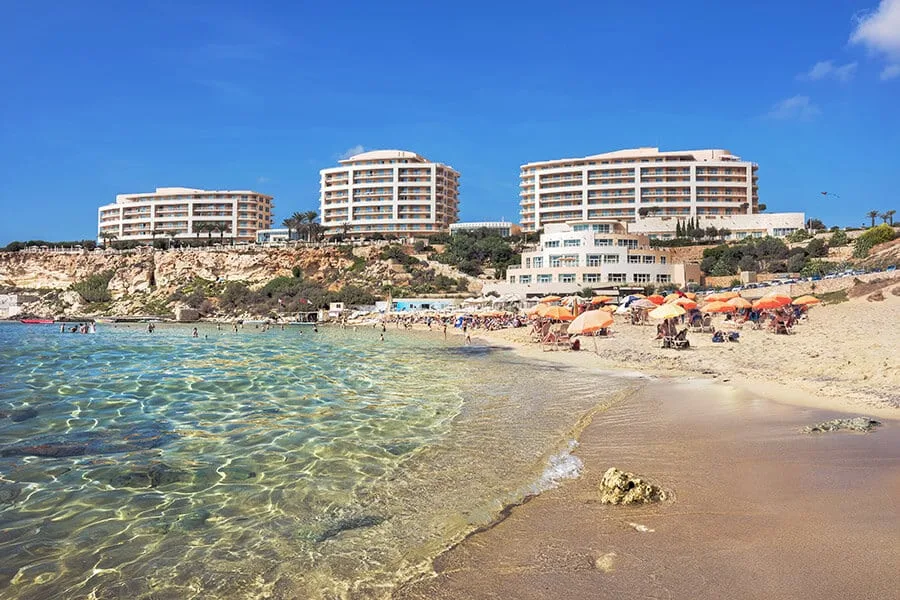
In Malta, the swimming season extends from May to October, offering six months of access to Blue Flag beaches with crystal-clear waters. Golden Bay beach is among the island's most favoured spots
Malta passport renewal
Once obtained, Maltese citizenship is valid for life. However, Malta passport holders need to renew their documents in the cases stated below.
Regular renewal
A passport validity period depends on the age of a citizen:
- up to 10 years old — passport is renewed every 2 years;
- from 10 to 15 years old — renewal is needed every 5 years;
- over 16 years old — the passport is valid for 10 years.
A passport renewal application is submitted at the Passport Office of Malta and processed within 4 days. If an individual is abroad, they can apply to the nearest Maltese embassy. In this case, the processing time is 3—4 months.
Loss or theft of a passport
To get a new passport replacing the one lost, stolen, or destroyed, a Maltese citizen needs to file a claim with the police to obtain a police report. The police report is submitted together with an application to the Passport Office of Malta.
If an individual is abroad, they report to the local Maltese embassy or consulate. The embassy issues a new passport or a travel document so that a citizen can go to Malta to apply for a new Maltese passport.
In case of loss, theft, or destruction of a passport, a citizen must take an oath when a new document is issued.
Change of personal details
After changing a name, surname, or other information, a Maltese citizen needs to renew their passport as well. In this case, the procedure is the same as for regular passport renewal.
Key takeaways on Malta citizenship
- There are 5 ways to acquire Malta citizenship: birth or descent, registration, which includes marriage, special grant of the President for distinguished service to Malta, getting citizenship as a refugee, and naturalisation.
- To obtain Malta citizenship by naturalisation, foreigners must first live in the country for 5 years and meet language requirements.
- Malta's legislation also allows individuals to apply for citizenship by merit if they make an exceptional contribution to the country. The process is discretionary.
- Malta allows dual citizenship, so foreigners do not have to renounce their first passport after getting a Maltese one.
- Maltese nationals can travel to 180 countries visa-free, live, work, study, and seek medical treatment in any EU country.
Immigrant Invest is a licensed agent for citizenship and residence by investment programs in the EU, the Caribbean, Asia, and the Middle East. Take advantage of our global 15-year expertise — schedule a meeting with our investment programs experts.
 Trusted by 10,000+ investors